
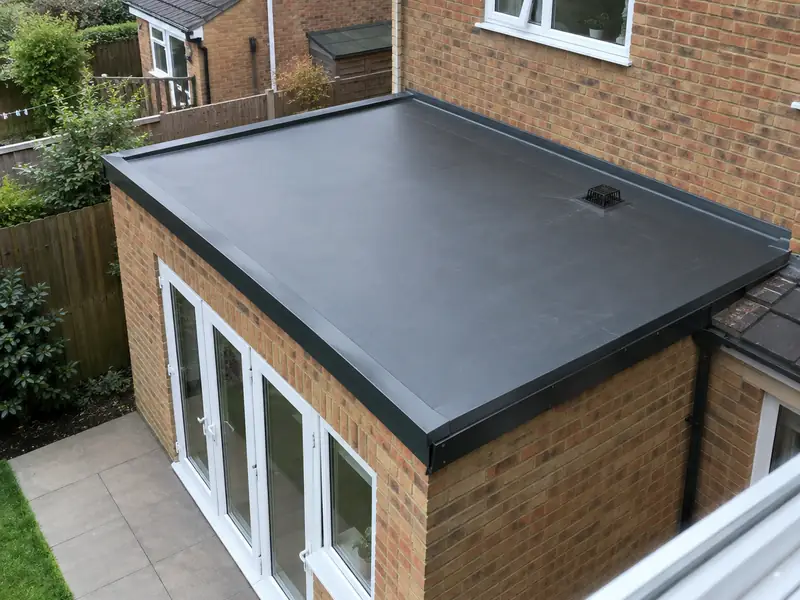
A flat roof replacement strips the old covering from a low-pitched roof and lays a new waterproof system, usually EPDM rubber, GRP fibreglass or torch-on felt, over a sound deck with correct falls, upstands, trims and outlets so rainwater drains away.
London is part of our UK-wide coverage for a new flat roof. Places we cover include Brent, Islington, Westminster and Bexley, and we travel to smaller communities across the area as well. Since your property is in England, the relevant planning and building rules are the ones set there. In London, budget around £2,600–£5,800 with VAT; the figure is confirmed after a survey that costs you nothing.
- Guide price
- £2,600–£5,800 inc VAT
- Time on site
- 1–3 days for most roofs
- Planning rules
- England
- Price level
- About 30% above the national guide
- Towns listed
- 90
- Survey
- Free, with a written quote
Flat roofs prices in London
Here is how the guide price for a new flat roof breaks down in London. We start from national figures and adjust for London, which comes out about 30% above the national guide. The resulting range, VAT included, is £2,600–£5,800, and a survey, at no cost to you, firms it up.
| Type of job | What it usually involves | Guide in London |
|---|---|---|
| Small roof (up to 8m²) | A dormer, bay, porch or small garage roof re-covered in EPDM or GRP. | £1,050–£2,600 |
| Extension or garage (15–25m²) | A typical extension or single garage roof stripped and re-covered. | £2,600–£5,800 |
| Large or new warm roof | Larger roofs, or roofs needing a new deck and insulation build-up. | £5,200–£11,500 |
What moves the price up or down:
- Roof area and access to the roof
- Condition of the deck and joists underneath
- Insulation upgrades and changes to roof height at edges
- Number of rooflights, pipes and upstands to detail
What do you get?
- Survey of the covering, deck, falls, upstands and drainage
- Replacement of rotten or soft deck boards
- Insulation upgrade to a warm roof build-up where agreed
- New EPDM, GRP or torch-on felt membrane laid to falls
- New trims, outlets and gutter connections
- Rooflights refitted or replaced where required
Homes in London
London's housing is dominated by Victorian and Edwardian terraces, often in yellow London stock brick, with Georgian terraces in central districts and mansion blocks across many inner areas. Outer boroughs have large belts of interwar semis, and there are extensive post-war council estates. Many houses have been split into flats, and conservation areas are widespread.
Terraces suit side-return extensions and rear dormer loft conversions; interwar semis commonly take hip-to-gable lofts. Shared party walls, restricted parking and conservation rules often shape the plans and the programme.
London Clay shrinks and swells with the seasons, and street trees close to houses can contribute to movement, which affects foundation design.
Do you need permission in London?
Homes in London come under the regulations for England, summarised below. We don't rely on general rules alone: we confirm the position for your address with the council before a quote goes out.
Re-roofing a house with similar materials does not usually need planning permission in England. Listed buildings and conservation areas may need consent if the covering changes.
Replacing more than a quarter of a roof’s covering counts as renovation under Building Regulations, so the work is notified and the roof insulation may need upgrading. Bats are protected across the UK; if they roost under roof tiles, soffits or fascias, work stops and a licensed ecologist advises before it restarts.
Rules change and every property is different, so we check the planning history and constraints for your address before we quote.
The four stages
Survey and measure
It starts with a survey at the property, free of charge. We check condition, access and services, ask how you want the finished result to look, and answer any questions you have about a new flat roof.
Quote in writing
Next you receive a written quote with a fixed price for the agreed specification. It lists what is included, what is not, and how payments are staged, so you can compare it properly.
Dates and permissions
Next comes planning the work itself. We set a start date that suits you, line up the right trades, and make sure any approvals for a new flat roof are in place before the first day on site.
Build and hand over
The work is carried out to the agreed specification, with floors and furniture protected and the site kept tidy. At the end we clean up, walk through the finished job with you and hand over any certificates.
What you can expect from us
Frequently asked questions
Do I need planning permission in London?
It depends on the work, the size of the project, your property type and whether the building is listed or in a conservation area. London is in England, so England's rules apply. Many smaller jobs need no planning application, but some still need building control approval. We check what applies to your address before quoting.
How long does a flat roof replacement take?
Replacing a typical extension or garage flat roof usually takes one to three days. Stripping and any deck repairs come first, then insulation where agreed, the new membrane and the trims and outlets. GRP needs dry weather and time to cure, and we plan around the forecast. Larger roofs or roofs with many rooflights take longer. We confirm timing with your quote.
Which is better, EPDM rubber or GRP fibreglass?
EPDM rubber and GRP fibreglass are both reliable modern flat roof systems. EPDM is a single flexible sheet with very few joints, which copes well with movement and suits most extensions and garages. GRP is a hard, seamless finish that copes better with foot traffic and complex shapes, but needs dry weather to apply. Felt costs less but usually lasts less long. We recommend a system after seeing your roof.
Can I stay at home during the work?
In most cases, yes. Most people can live at home throughout, and we plan the work to keep disruption down by protecting floors, agreeing working hours and keeping access routes clear. Bigger jobs affecting kitchens, bathrooms or heating may mean a short spell with reduced facilities, and we talk this through with you at the survey.
How long does a flat roof last?
A well-installed EPDM or GRP flat roof can last 25 years or more, while torch-on felt systems typically last around 15–25 years, depending on quality and exposure. Lifespan depends on correct falls, good detailing at edges and upstands, and keeping outlets clear. Foot traffic, ponding and poor ventilation shorten it. Annual checks help catch small problems early.
Towns in London
Looking for a new flat roof somewhere in London? Start with the towns below; each links to a page with pricing for your region and coverage details.
- Acton
- Archway
- Barking
- Barnes
- Barnet
- Battersea
- Beckenham
- Becontree
- Bexley
- Blackheath
- Blackwall
- Bow
- Brent
- Brixton
- Camden Town
- Canary Wharf
- Canning Town
- Carshalton
- Catford
- Chalk Farm
- Chelsea
- Chessington
- Chingford
- Chiswick
- Coulsdon
- Cricklewood
- Croydon
- Dagenham
- East Barnet
- Edmonton
- Eltham
- Enfield Town
- Feltham
- Finchley
- Fulham
- Golders Green
- Greenford
- Greenwich
- Hadley Wood
- Hampton
- Hanworth
- Harrow
- Hayes
- Heston
- Highbury
- Holloway
- Hook
- Hornchurch
- Hounslow
- Ilford
- Isleworth
- Islington
- Kilburn
- Leytonstone
- Mitcham
- Morden
- Muswell Hill
- New Malden
- Northolt
- Notting Hill
- Peckham
- Pimlico
- Pinner
- Purley
- Putney
- Richmond
- Romford
- Ruislip
- Shepherds Bush
- Soho
- South Croydon
- Southall
- Stamford Hill
- Stratford
- Streatham
- Surbiton
- Sutton
- Thamesmead
- Tottenham
- Uxbridge
- Wallington
- Walthamstow
- Wealdstone
- Welling
- Wembley
- Westminster
- Willesden
- Wimbledon
- Wood Green
- Woodford Green