
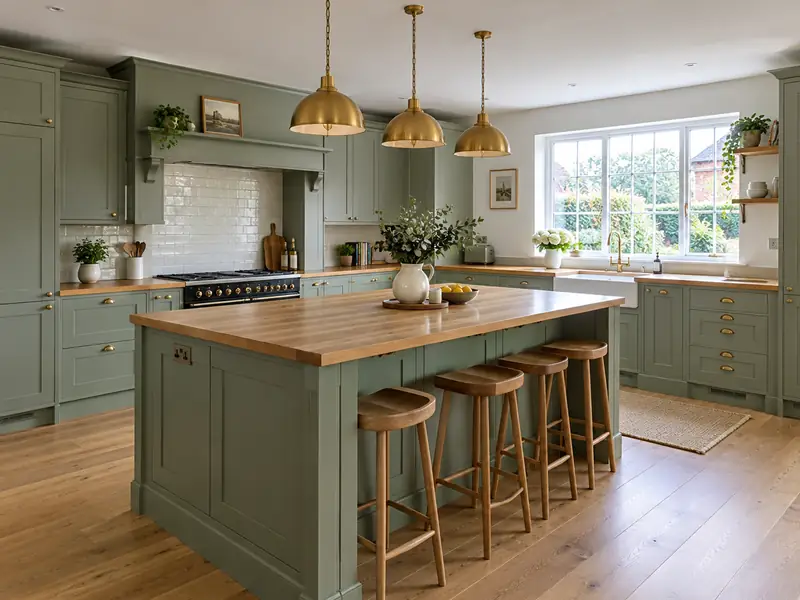
A new kitchen installation replaces your old units, worktops and appliances with a new layout fitted to your room, including the plumbing, electrics, tiling and finishing needed to leave a complete, working kitchen.
Looking for a new kitchen in County Down? We organise the whole job, bringing in the trades it needs under one agreement, and you have a single contact. We cover Bangor, County Down, Castlereagh, Newtownards and Newry, along with villages and suburbs nearby. The rules in Northern Ireland decide what consents are needed, and our guide range of £6,900–£19,000 including VAT gives you a realistic starting point for a budget.
- Guide price
- £6,900–£19,000 inc VAT
- Time on site
- 1–3 weeks on site
- Planning rules
- Northern Ireland
- Price level
- About 14% below the national guide
- Towns listed
- 5
- Survey
- Free, with a written quote
How much does a new kitchen cost in County Down?
To help you plan, we show what a new kitchen typically costs in County Down instead of holding figures back for a sales call. The range is £6,900–£19,000 with VAT, using rates in Northern Ireland that are about 14% below the national guide. A free survey then fixes your actual price.
| Type of job | What it usually involves | Guide in County Down |
|---|---|---|
| Value kitchen | Standard units and laminate worktops in a small or medium room, keeping the existing layout. | £4,300–£7,700 |
| Mid-range kitchen | Better units, some layout changes, built-in appliances and a choice of worktops. | £7,700–£17,000 |
| Premium kitchen | High-end units, stone worktops, an island and premium appliances in a larger room. | £17,000–£34,500 |
What moves the price up or down:
- Length of units and the size of the room
- Unit range, door finish and worktop material
- Moving the sink, hob or other services to a new position
- Appliances, including built-in and premium models
What do you get?
- Removal and disposal of the old kitchen
- Plumbing for sink, dishwasher and washing machine
- Gas connections by a suitably registered engineer where needed
- Units, worktops and appliances fitted, levelled and adjusted
- Splashbacks or wall tiling to your chosen design
- Making good, extractor ducting and a final clean
Housing across County Down
County Down takes in suburbs of Belfast, Bangor and Holywood with Victorian and Edwardian villas, and Newry, Downpatrick and Banbridge with older town centres and newer estates. Mourne granite appears in buildings around the mountains, and detached rural homes and bungalows are common across the county, often rendered or pebbledashed.
Villas and semis suit kitchen extensions, loft conversions and garden landscaping. Rural detached homes commonly take extensions and driveways, and rendered houses often need re-rendering, roofline renewal and window replacement.
Coastal areas such as the Ards Peninsula face salt and wind, and the Mournes bring heavier rain and colder conditions.
Do you need permission in County Down?
Each UK nation sets its own consent rules, and County Down is in Northern Ireland. What follows is a plain summary; we check the specifics for your property with the council before pricing anything.
Internal improvements do not need planning permission in Northern Ireland unless the building is listed.
The Building Regulations (Northern Ireland) apply to structural work, drainage and ventilation; electrical work should be tested and certified.
Rules change and every property is different, so we check the planning history and constraints for your address before we quote.
From survey to handover
Survey and measure
A free survey comes first. It gives us what we need to price a new kitchen properly, including dimensions, existing materials and access for deliveries, and gives you the chance to ask anything you like.
Your fixed price
The quote arrives in writing, not over the phone. It covers the full scope, the finishes you've chosen, any exclusions and the payment schedule, with a fixed price tied to that specification.
Plan and prepare
With the quote agreed, we book the work in and handle preparation: permissions where needed, building control notifications, material orders and access arrangements for your County Down property.
Build and hand over
Our trades complete a new kitchen while your point of contact keeps you updated. When everything is finished, we clear the site, take away waste and go through the result with you before handover.
How we work
Frequently asked questions
How much does a new kitchen cost?
A mid-range kitchen of around 5–7 linear metres of units costs £6,900–£19,000 supplied and fitted. Value kitchens in smaller rooms cost less, and premium kitchens with stone worktops, an island and high-end appliances cost more. Moving the sink or hob, new electrics and replastering also affect the total. As a guide, allow roughly £1,000–£2,800 per linear metre of units plus fixed fitting costs. We confirm a fixed price after the survey.
Is the price fixed?
Yes, for the specification we agree. Your written quote sets out exactly what is included at a fixed price. It only changes if you ask for something different, or if a problem the survey could not reasonably reveal later needs extra work. In either case we explain the change and confirm it in writing before going ahead.
Can a new kitchen be part of a knock-through?
A new kitchen often goes hand in hand with removing a wall to create an open-plan kitchen-diner. The wall removal, steel beam and building control approval are done first, then the plastering, and finally the kitchen is fitted into the new space. Doing both under one plan avoids fitting a kitchen twice and lets you design the layout for the larger room.
Can I move my sink or cooker to a new position?
Moving the sink, hob or cooker is usually possible but adds cost, because waste pipes, water supplies, gas and electrics have to be rerouted. Sinks need waste pipes to fall towards the drain, so the position of the outside wall matters. Hobs may need a new circuit or gas run and a suitable extractor route. We check what is practical during the survey and price each change separately.
Can I stay at home during the work?
In most cases, yes. Most people can live at home throughout, and we plan the work to keep disruption down by protecting floors, agreeing working hours and keeping access routes clear. Bigger jobs affecting kitchens, bathrooms or heating may mean a short spell with reduced facilities, and we talk this through with you at the survey.
Towns in County Down
Choose your town from the list to see how we price and plan a new kitchen in your part of County Down, including typical time on site.