
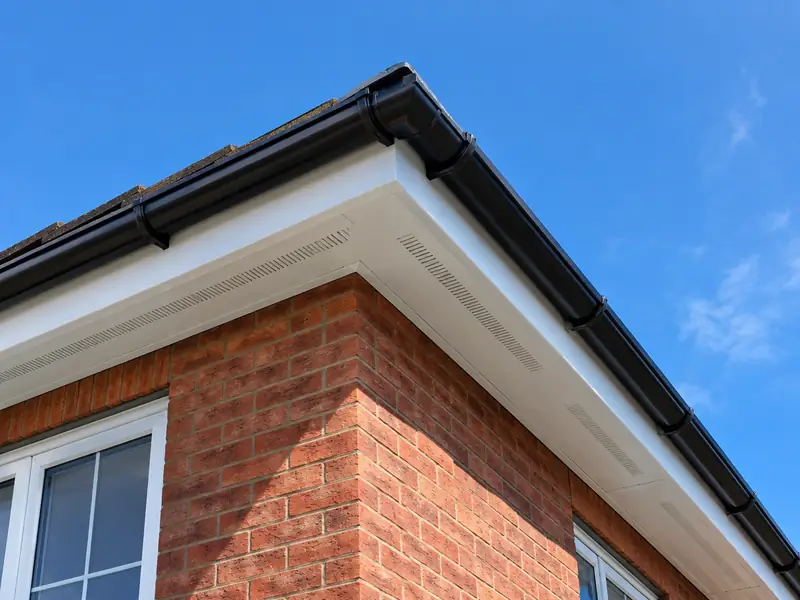
Roofline replacement renews the fascia boards that carry your gutters, the soffits beneath the eaves, bargeboards on gable ends and the gutters and downpipes, usually in low-maintenance uPVC, to protect rafter ends and carry rainwater safely away.
From Bangor, County Down, Castlereagh, Newtownards and Newry to the quieter corners of County Down, homeowners can book a free survey for new fascias, soffits and guttering. We look at the building, agree the scope, then send a quote in writing that fixes the cost of that scope. Work follows the rules for Northern Ireland, and our published range for Northern Ireland, £1,700–£3,900 with VAT, gives you a sense of budget before we visit.
- Guide price
- £1,700–£3,900 inc VAT
- Time on site
- 1–3 days for a typical house
- Planning rules
- Northern Ireland
- Price level
- About 14% below the national guide
- Towns listed
- 5
- Survey
- Free, with a written quote
How much do new fascias, soffits and guttering cost in County Down?
In County Down, guide figures for new fascias, soffits and guttering sit at £1,700–£3,900, VAT included. We set them using rates for Northern Ireland, currently about 14% below the national guide. The table shows what pushes a project towards either end of the range; your own price is set after a free survey.
| Type of job | What it usually involves | Guide in County Down |
|---|---|---|
| Guttering and downpipes only | New gutters and downpipes on a typical house, where fascias are sound. | £350–£1,300 |
| Full roofline on a semi | Fascias, soffits, gutters and downpipes on the front and rear of a 3-bed semi. | £1,700–£3,900 |
| Detached or with bargeboards | Larger houses, gable bargeboards, dormers or extensive rafter repairs. | £3,400–£6,900 |
Your price depends mostly on:
- Length of eaves and number of gable ends
- Rafter end repairs found when old boards come off
- Scaffolding and access, including over conservatories
- Number of downpipes and drain connections
Scope of the work
- Survey of boards, rafter ends, gutters and eaves ventilation
- Scaffolding or access towers as needed
- Removal and disposal of old fascias, soffits and gutters
- New uPVC fascias, soffits and bargeboards in your chosen colour
- Eaves ventilation and tile support trays fitted
- Downpipes connected to existing drains and the site cleaned
Homes in County Down
County Down takes in suburbs of Belfast, Bangor and Holywood with Victorian and Edwardian villas, and Newry, Downpatrick and Banbridge with older town centres and newer estates. Mourne granite appears in buildings around the mountains, and detached rural homes and bungalows are common across the county, often rendered or pebbledashed.
Villas and semis suit kitchen extensions, loft conversions and garden landscaping. Rural detached homes commonly take extensions and driveways, and rendered houses often need re-rendering, roofline renewal and window replacement.
Coastal areas such as the Ards Peninsula face salt and wind, and the Mournes bring heavier rain and colder conditions.
Planning and building rules in County Down
Planning law differs across the UK. For a home in County Down, it is the Northern Ireland rules below that count, and we check them with the council ahead of any quote.
Replacing fascias, soffits and guttering does not normally need planning permission in Northern Ireland.
Like-for-like roofline work is not normally covered by building control. Bats are protected across the UK; if they roost under roof tiles, soffits or fascias, work stops and a licensed ecologist advises before it restarts.
Rules change and every property is different, so we check the planning history and constraints for your address before we quote.
From survey to handover
Survey and measure
Book a visit and we'll come to you. The survey covers measurements, the state of what's there now and any obvious constraints, so the price that follows is based on your actual home, not an average.
Your fixed price
You get the price in writing, itemised so you can see where the money goes. As long as the specification stays the same, that is the price you pay for new fascias, soffits and guttering.
Plan and prepare
We handle the paperwork side: checking whether planning permission or building control approval is needed, submitting applications where they are, and scheduling the trades and materials around your dates.
Build and hand over
The work is carried out to the agreed specification, with floors and furniture protected and the site kept tidy. At the end we clean up, walk through the finished job with you and hand over any certificates.
How we work
Frequently asked questions
Do you need to access the roof tiles?
Replacing fascias usually means lifting or supporting the bottom row of roof tiles, because the felt or membrane must run over the new fascia into the gutter. Eaves protection trays are fitted to replace perished felt at the edge and stop rain getting behind the gutter. The tiles are then refixed. We include this detail in every full roofline replacement.
How do I look after uPVC roofline?
uPVC fascias and soffits need little upkeep: wash them once or twice a year with warm soapy water and a soft brush, avoiding solvents and abrasive cleaners. Gutters need clearing at least once a year, usually in late autumn, and more often near trees. Check downpipes are running clear after heavy rain. Gutter guards can reduce how often clearing is needed.
How long will new fascias, soffits and guttering take?
On a typical home, allow 1–3 days for a typical house. Larger projects, older buildings and extra work found once things are opened up can extend that, while simpler jobs may be shorter. Your quote includes an estimate of time on site, and your point of contact keeps you updated on the programme as the work progresses.
Can I stay at home during the work?
In most cases, yes. Most people can live at home throughout, and we plan the work to keep disruption down by protecting floors, agreeing working hours and keeping access routes clear. Bigger jobs affecting kitchens, bathrooms or heating may mean a short spell with reduced facilities, and we talk this through with you at the survey.
Why is roof ventilation important at the eaves?
Ventilation at the eaves lets air flow into the roof space and out at the ridge, carrying away moisture that would otherwise condense on cold timbers. Poor ventilation can lead to damp, mould and rot in the loft. Many older soffits have no vents, and loft insulation can block airflow. New soffits and eaves trays are fitted to keep a clear air path.
Towns in County Down
Below is our list of County Down towns for new fascias, soffits and guttering. If yours isn't shown, we may still cover it, so it is worth asking us directly.