
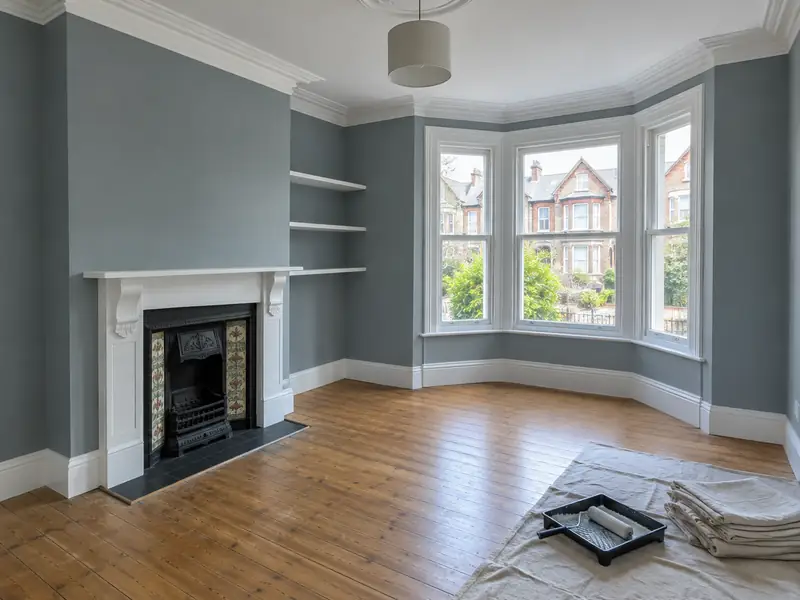
Painting and decorating is preparing and finishing the surfaces of a home, including filling, sanding, priming and painting walls, ceilings and woodwork, hanging wallpaper and painting exterior walls and joinery, to protect them and refresh how rooms look.
Homes across London vary a great deal, so we price painting and decorating only after seeing the property. Our coverage takes in Brent, Islington, Westminster and Bexley and the surrounding districts. As a guide, expect £1,550–£3,900 including VAT in London; the final figure depends on size, materials and access. Any permissions are checked against the rules for England before we quote.
- Guide price
- £1,550–£3,900 inc VAT
- Time on site
- 1–2 days per room; 3–7 days for a house exterior
- Planning rules
- England
- Price level
- About 30% above the national guide
- Towns listed
- 90
- Survey
- Free, with a written quote
Painting and decorating prices in London
What should you budget for painting and decorating in London? Use the figures below as a starting point. Prices in London sit about 30% above the national guide, so the range here is £1,550–£3,900 including VAT. Your fixed price comes in writing once we've surveyed the property, at no charge.
| Type of job | What it usually involves | Guide in London |
|---|---|---|
| Single room | Walls, ceiling and woodwork in one average bedroom or living room. | £450–£1,150 |
| House exterior | Masonry and joinery on a typical semi, including access equipment. | £3,200–£7,800 |
| Whole interior of a 3-bed house | Every room, hallway, stairs and landing, including woodwork. | £3,900–£8,400 |
Your price depends mostly on:
- Number and size of rooms, including ceiling height
- Amount of preparation, filling and repairs needed
- Whether woodwork, doors and wallpaper are included
- Exterior access, scaffolding and the condition of surfaces
Scope of the work
- Floors, furniture and fittings protected with dust sheets and masking
- Filling cracks and holes, sanding and spot priming
- Two finishing coats to walls and ceilings as standard
- Woodwork sanded, primed where bare, and painted
- Wallpaper stripped or hung where included
- Furniture replaced, waste removed and a final tidy-up
Housing across London
London's housing is dominated by Victorian and Edwardian terraces, often in yellow London stock brick, with Georgian terraces in central districts and mansion blocks across many inner areas. Outer boroughs have large belts of interwar semis, and there are extensive post-war council estates. Many houses have been split into flats, and conservation areas are widespread.
Terraces suit side-return extensions and rear dormer loft conversions; interwar semis commonly take hip-to-gable lofts. Shared party walls, restricted parking and conservation rules often shape the plans and the programme.
London Clay shrinks and swells with the seasons, and street trees close to houses can contribute to movement, which affects foundation design.
Planning and building rules in London
Planning law differs across the UK. For a home in London, it is the England rules below that count, and we check them with the council ahead of any quote.
Internal work such as a new kitchen, bathroom, flooring, plastering or decorating does not need planning permission in England, unless the house is listed, when listed building consent may be needed even for internal changes.
Some internal work is covered by Building Regulations: new electrical circuits and work in bathrooms (Part P), new drainage, structural changes, extractor ventilation and any new window. Notifiable work is certified by a registered installer or by building control.
Rules change and every property is different, so we check the planning history and constraints for your address before we quote.
From survey to handover
Free site survey
First, someone visits your home in London to see the space, take measurements and note anything that could affect the work, such as access or the condition of what is there. There is no charge for this visit.
Price and scope agreed
We put everything into a written, fixed-price quote: the specification, what's excluded, staged payments and the expected time on site. Take whatever time you need to decide; there's no pressure to commit.
Dates and permissions
Next comes planning the work itself. We set a start date that suits you, line up the right trades, and make sure any approvals for painting and decorating are in place before the first day on site.
On site to finish
On site, the agreed plan is followed and any change is put in writing first. At completion we do a final clean, go through the snagging list with you and leave you with the relevant documents.
How we work
Frequently asked questions
Why is preparation so important?
Preparation decides how good the finish looks and how long it lasts. Filling cracks, sanding glossy surfaces, washing greasy areas and priming bare wood all help paint grip and dry evenly. Skipping it leads to visible repairs, peeling and patchy colour. Most of the time on a decorating job goes into preparation, and our quotes always allow for it.
What paint finish should I choose?
Matt emulsion hides imperfections and gives a soft look, which suits ceilings and living rooms. Eggshell or soft sheen finishes are more washable, so they suit kitchens, hallways and children's rooms. For woodwork, satin gives a modern low-shine look, while gloss is harder-wearing and more traditional. Bathrooms benefit from paints made to resist moisture and mould.
Can I stay at home during the work?
In most cases, yes. Most people can live at home throughout, and we plan the work to keep disruption down by protecting floors, agreeing working hours and keeping access routes clear. Bigger jobs affecting kitchens, bathrooms or heating may mean a short spell with reduced facilities, and we talk this through with you at the survey.
Is the price fixed?
Yes, for the specification we agree. Your written quote sets out exactly what is included at a fixed price. It only changes if you ask for something different, or if a problem the survey could not reasonably reveal later needs extra work. In either case we explain the change and confirm it in writing before going ahead.
How much does it cost to decorate a room?
Decorating an average room costs roughly £350–£900, covering walls, ceiling and woodwork, while three rooms typically come to £1,550–£3,900. Large living rooms, high ceilings, stairwells and wallpapering cost more, and so do rooms needing a lot of filling and sanding. Strong colour changes may need an extra coat. We confirm a fixed price for the agreed rooms after the survey.
Towns in London
Below is our list of London towns for painting and decorating. If yours isn't shown, we may still cover it, so it is worth asking us directly.
- Acton
- Archway
- Barking
- Barnes
- Barnet
- Battersea
- Beckenham
- Becontree
- Bexley
- Blackheath
- Blackwall
- Bow
- Brent
- Brixton
- Camden Town
- Canary Wharf
- Canning Town
- Carshalton
- Catford
- Chalk Farm
- Chelsea
- Chessington
- Chingford
- Chiswick
- Coulsdon
- Cricklewood
- Croydon
- Dagenham
- East Barnet
- Edmonton
- Eltham
- Enfield Town
- Feltham
- Finchley
- Fulham
- Golders Green
- Greenford
- Greenwich
- Hadley Wood
- Hampton
- Hanworth
- Harrow
- Hayes
- Heston
- Highbury
- Holloway
- Hook
- Hornchurch
- Hounslow
- Ilford
- Isleworth
- Islington
- Kilburn
- Leytonstone
- Mitcham
- Morden
- Muswell Hill
- New Malden
- Northolt
- Notting Hill
- Peckham
- Pimlico
- Pinner
- Purley
- Putney
- Richmond
- Romford
- Ruislip
- Shepherds Bush
- Soho
- South Croydon
- Southall
- Stamford Hill
- Stratford
- Streatham
- Surbiton
- Sutton
- Thamesmead
- Tottenham
- Uxbridge
- Wallington
- Walthamstow
- Wealdstone
- Welling
- Wembley
- Westminster
- Willesden
- Wimbledon
- Wood Green
- Woodford Green