
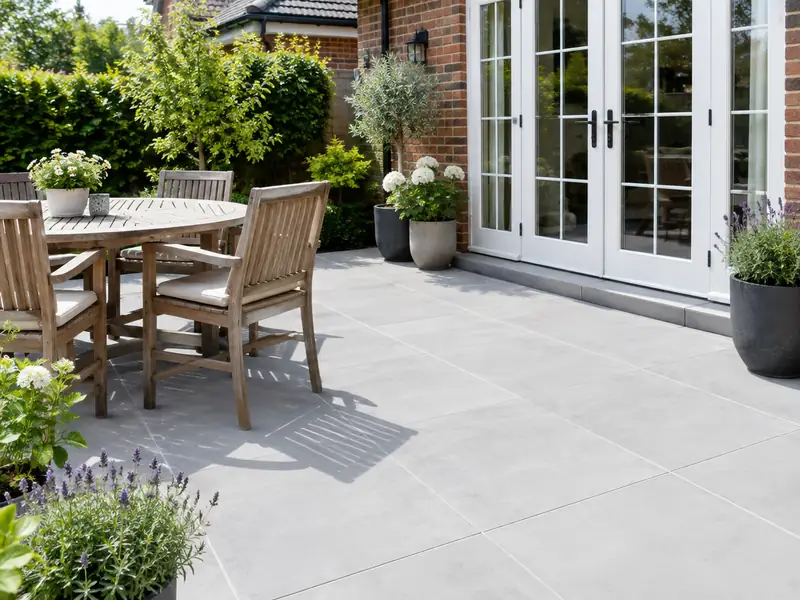
A patio is a paved outdoor area next to the house or in the garden, laid in porcelain, natural stone or concrete slabs on a compacted sub-base and mortar bed, with falls that direct rainwater away from the house.
Anyone planning a new patio in Hull wants three things: a clear price, a realistic timetable and a tidy job. We publish a guide of £2,400–£5,200 including VAT for Yorkshire and the Humber up front, explain that work normally takes 3–7 days on site, and confirm both in writing after a free survey of your property.
- Guide price
- £2,400–£5,200 inc VAT
- Time on site
- 3–7 days on site
- Postcodes
- HU1, HU2, HU3, HU5 and HU8
- Planning rules
- England
- Local area
- City of Kingston-upon-Hull
- Survey
- Free, with a written quote
What should you budget for a new patio in Hull?
Use the table to gauge the cost of a new patio in Hull before we visit. Figures include VAT and are scaled for Yorkshire and the Humber, coming out about 6% below the national guide, which gives £2,400–£5,200 overall. After a free survey, you receive a fixed written price.
| Type of job | What it usually involves | Guide in Hull |
|---|---|---|
| Small patio or path | Around 10m² of concrete slabs or a garden path. | £950–£2,400 |
| Typical 20m² patio | Sandstone or porcelain on a full sub-base with jointing and edging. | £2,400–£5,200 |
| Large or multi-level patio | Bigger areas, steps, retaining walls or premium stone. | £5,200–£11,500 |
What moves the price up or down:
- Slab material, size and laying pattern
- Ground levels, slopes, steps and retaining walls
- Drainage needed to keep water away from the house
- Access for materials and removing spoil
What do you get?
- Compacted MOT Type 1 sub-base
- Slabs laid on a full mortar bed with falls away from the house
- Primer on porcelain slabs for a strong bond
- Jointing with mortar or a brush-in compound
- Edging and neat cuts around drains and walls
- Site cleared, waste removed and paving cleaned
Local housing and a new patio
Hull has large areas of Victorian and Edwardian terraces, many arranged in the city's distinctive short cul-de-sac terraces running off the main streets, plus extensive interwar and post-war estates. Beverley keeps Georgian brick houses, Wolds villages use chalk and brick, and red clay pantile roofs are common across the area. Coastal towns such as Bridlington mix guest-house terraces with bungalows.
Terraced homes often suit loft rooms and rear extensions; pantile roofs may need re-roofing with matching tiles. Bungalows commonly benefit from loft conversions, and older brick houses need repointing with a suitable mortar.
In Hull, as elsewhere in East Riding of Yorkshire, we take the building's age and construction into account before recommending anything, because both can change what is involved in a new patio.
Permissions for a new patio in Hull
Hull is in England, so the planning and building rules set out below are the ones that apply. We confirm the details with the council before we quote.
A ground-level patio in a back garden does not usually need planning permission in England. Raised decks or platforms more than 30 cm high do.
Building Regulations do not normally apply to patios, but levels must stay below the damp-proof course and drain away from the house.
Rules change and every property is different, so we check the planning history and constraints for your address before we quote.
From survey to handover
Free site survey
We begin by looking at the job in person. During the free survey we discuss options, materials and budget for a new patio, and photograph or measure anything the quote needs to reflect.
Quote in writing
The quote arrives in writing, not over the phone. It covers the full scope, the finishes you've chosen, any exclusions and the payment schedule, with a fixed price tied to that specification.
Dates and permissions
Preparation matters as much as the build. We agree access, parking and working hours with you, order materials in good time, and confirm any permissions so the job isn't held up once it starts.
Build and hand over
Our trades complete a new patio while your point of contact keeps you updated. When everything is finished, we clear the site, take away waste and go through the result with you before handover.
Why homeowners choose us
Patios and paving in Hull: questions
Is the price fixed?
Yes, for the specification we agree. Your written quote sets out exactly what is included at a fixed price. It only changes if you ask for something different, or if a problem the survey could not reasonably reveal later needs extra work. In either case we explain the change and confirm it in writing before going ahead.
How do you make sure water drains away from the house?
A patio needs a gentle fall, usually a little over 1 in 80, so rainwater runs away from the house towards the garden, a drain or a soakaway. The surface should also sit well below the damp-proof course. If the patio meets a door threshold, a channel drain may be needed. We set levels with string lines and check falls as we lay each section.
Does a patio need planning permission?
Most patios do not need planning permission, but it depends on the size, height and location, your home's position, whether it is listed or in a conservation area, and which UK nation you are in. Raised patios or decking more than a small height above the ground may need permission because of overlooking. We check the position for your garden before quoting.
How do I clean and look after my patio?
Most patios just need regular sweeping and an occasional wash with water and a mild patio cleaner. Porcelain is the easiest to keep clean. Natural stone benefits from a sealant to reduce staining and from prompt cleaning of spills like oil or wine. Re-point any joints that crack or wash out. Avoid high-pressure jet washing close to joints, which can damage them.
Can you combine a new patio with other work?
Yes. Because we manage several trades under one contract, we can plan a new patio alongside other work on your Hull home, such as new windows with rendering, or a kitchen refit with an extension. Combining jobs can reduce repeat set-up such as scaffolding, skips and access, and every element is listed and priced in the same written quote.
Also covering areas around Hull
From HU1, HU2, HU3 and HU5 to the edges of Hull and on into Beverley, Brough and Grimsby, we can arrange a site visit and a written quote for your project, planned around dates that work for you.