
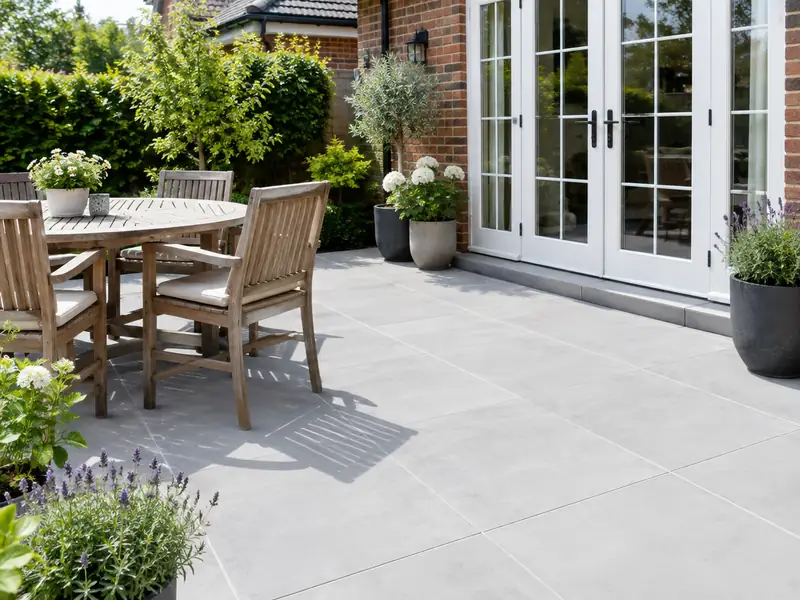
A patio is a paved outdoor area next to the house or in the garden, laid in porcelain, natural stone or concrete slabs on a compacted sub-base and mortar bed, with falls that direct rainwater away from the house.
Getting a new patio right in Rhondda starts with understanding the house you already have: its age, how it was built and what has been altered over the years. We survey first, then commit on paper to a price that holds as long as the scope stays the same. Across Wales, guide prices run at £2,300–£5,100 including VAT, and homes in Tonypandy, Aberdare and Pontypridd are covered too.
- Guide price
- £2,300–£5,100 inc VAT
- Time on site
- 3–7 days on site
- Postcodes
- CF41 and CF43
- Planning rules
- Wales
- Local area
- Rhondda Cynon Taff
- Survey
- Free, with a written quote
How much does a new patio cost in Rhondda?
Below is a breakdown of typical costs for a new patio in Rhondda. Because rates in Wales are about 8% below the national guide, the overall guide comes to £2,300–£5,100, including VAT. Size, materials and access move the figure, and a free-of-charge survey settles it.
| Type of job | What it usually involves | Guide in Rhondda |
|---|---|---|
| Small patio or path | Around 10m² of concrete slabs or a garden path. | £900–£2,300 |
| Typical 20m² patio | Sandstone or porcelain on a full sub-base with jointing and edging. | £2,300–£5,100 |
| Large or multi-level patio | Bigger areas, steps, retaining walls or premium stone. | £5,100–£11,000 |
Expect these to shape the final quote:
- Slab material, size and laying pattern
- Ground levels, slopes, steps and retaining walls
- Drainage needed to keep water away from the house
- Access for materials and removing spoil
What’s included?
- Survey of levels, damp-proof course, drainage and access
- Compacted MOT Type 1 sub-base
- Primer on porcelain slabs for a strong bond
- Jointing with mortar or a brush-in compound
- Edging and neat cuts around drains and walls
- Site cleared, waste removed and paving cleaned
What are homes like around Rhondda?
The Rhondda, Cynon and Merthyr valleys are lined with stone terraces built for mining families, stepped along steep hillsides. Pontypridd, Caerphilly and Merthyr Tydfil have Victorian centres, and Bridgend has grown with large modern estates alongside interwar and post-war housing.
Valley terraces commonly need repointing, roof repairs, rendering and window replacement, and loft conversions can add useful space. Newer estate homes often take garage conversions, porches and landscaping.
That variety is why a guide price for a new patio in Rhondda is only a starting point; the survey shows what your particular property needs.
Planning and building rules in Rhondda
The notes below cover Wales, which is where Rhondda sits. Rules change and every property is different, so we speak to the council before pricing your job.
A ground-level patio does not usually need planning permission in Wales; raised platforms are more restricted.
Building Regulations do not normally apply, but levels and drainage must protect the house walls.
Rules change and every property is different, so we check the planning history and constraints for your address before we quote.
How does the job run?
We look at the job
It starts with a survey at the property, free of charge. We check condition, access and services, ask how you want the finished result to look, and answer any questions you have about a new patio.
Quote in writing
We turn the survey notes into a written quote. The price is fixed for the specification we agree, and the document sets out materials, scope and payment stages in plain language.
Dates and permissions
Before anyone starts, we confirm the programme in writing, check whether consents are required and arrange deliveries. If a skip or scaffolding on the road needs a permit, we apply for it.
The work itself
Work goes ahead as scheduled and you deal with one contact throughout. When the last trade leaves, we clear and clean the site, talk you through what has been done and pass on any certificates and care instructions.
Why homeowners choose us
Patios and paving in Rhondda: questions
What happens if my garden slopes?
A sloping garden can still have a level patio by cutting into the slope, building up with retaining walls, or creating terraces with steps between them. Retaining walls must be built to hold back the soil and allow drainage behind them. This adds cost but creates usable, level space. We look at the slope during the survey and suggest the most practical design.
How do I clean and look after my patio?
Most patios just need regular sweeping and an occasional wash with water and a mild patio cleaner. Porcelain is the easiest to keep clean. Natural stone benefits from a sealant to reduce staining and from prompt cleaning of spills like oil or wine. Re-point any joints that crack or wash out. Avoid high-pressure jet washing close to joints, which can damage them.
Can I stay at home during the work?
In most cases, yes. Most people can live at home throughout, and we plan the work to keep disruption down by protecting floors, agreeing working hours and keeping access routes clear. Bigger jobs affecting kitchens, bathrooms or heating may mean a short spell with reduced facilities, and we talk this through with you at the survey.
How much does a new patio cost?
A typical 20m² patio in sandstone or porcelain costs £2,300–£5,100, including excavation, sub-base, laying and jointing. As a guide, allow roughly £100–£220 per square metre plus fixed costs for set-up and waste. Concrete slabs cost less, while slate, granite and large-format porcelain cost more. Steps, walls and drainage add to the total. We confirm a fixed price after the survey.
How long will a new patio take?
On a typical home, allow 3–7 days on site. Larger projects, older buildings and extra work found once things are opened up can extend that, while simpler jobs may be shorter. Your quote includes an estimate of time on site, and your point of contact keeps you updated on the programme as the work progresses.
Also covering areas around Rhondda
Live in Rhondda? Our coverage takes in the CF41 and CF43 postcode areas and reaches out to Tonypandy, Aberdare and Pontypridd, so homes on the outskirts and in the next town along are included.