
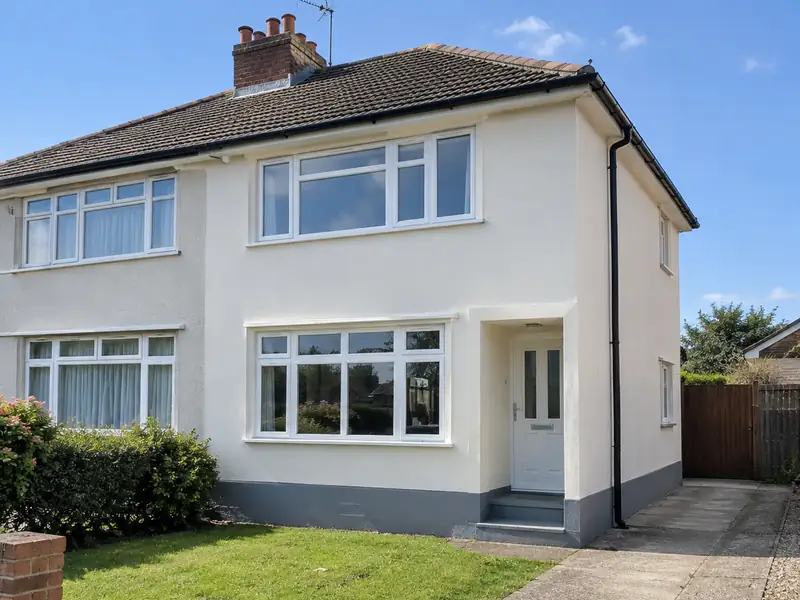
External rendering is applying a protective, weather-resistant coating to the outside walls of a house, using sand and cement, monocouche or thin-coat silicone render, to give a smooth or textured finish that protects the masonry and improves appearance.
Getting external rendering right in Crewe starts with understanding the house you already have: its age, how it was built and what has been altered over the years. We survey first, then commit on paper to a price that holds as long as the scope stays the same. Across the North West, guide prices run at £6,600–£15,000 including VAT, and homes in Winsford, Kidsgrove and Congleton are covered too.
- Guide price
- £6,600–£15,000 inc VAT
- Time on site
- 1–3 weeks on site, depending on weather
- Postcodes
- CW1 and CW2
- Planning rules
- England
- Local area
- Cheshire East
- Survey
- Free, with a written quote
How much does external rendering cost in Crewe?
Below is a breakdown of typical costs for external rendering in Crewe. Because rates in the North West are about 5% below the national guide, the overall guide comes to £6,600–£15,000, including VAT. Size, materials and access move the figure, and a free-of-charge survey settles it.
| Type of job | What it usually involves | Guide in Crewe |
|---|---|---|
| Front elevation or small terrace | One elevation or a small terraced house, including scaffolding and preparation. | £2,800–£6,600 |
| Typical semi-detached | All rendered walls of a 3-bed semi in monocouche or silicone, with scaffolding. | £6,600–£15,000 |
| Detached or full strip and re-render | Larger houses, or homes needing old render removed and walls repaired first. | £14,000–£28,500 |
What moves the price up or down:
- Wall area to be rendered and the height of the house
- Removing old render or pebbledash and repairing the walls
- Scaffolding, access and protection of neighbouring property
- Detailing around windows, bays, sills and pipes
Scope of the work
- Survey of walls, existing render, cracks and damp-proof course
- Scaffolding erected and removed, with neighbours' access agreed
- Removal of loose or failed render and pebbledash where needed
- Windows, doors and surfaces masked and protected
- Mesh reinforcement and base coats to suit the chosen system
- Finish coat in your chosen colour and texture
Local housing and external rendering
Chester mixes Georgian and Victorian terraces with black-and-white revival frontages, and red sandstone shows up across the west of the county. Crewe has railway-era brick terraces, Macclesfield has mill workers' cottages, and Wilmslow, Knutsford and Alderley Edge are known for large detached homes. Interwar semis and newer estates surround Warrington and Northwich.
The Cheshire Plain is fairly mild, but rainfall rises towards the Pennine edge, and parts of mid Cheshire have a history of subsidence linked to salt extraction.
Whatever era your Crewe home dates from, we plan external rendering around how it is actually built rather than a one-size-fits-all specification.
Planning and building rules in Crewe
Which rules apply depends on where you live. For Crewe, the answer is England, and the points below reflect that; we verify them with the council before quoting.
In England, re-rendering or cladding a house is often allowed without planning permission, but stone, render, timber, plastic or tile cladding is not permitted development in conservation areas, and listed buildings need consent.
If you render or re-clad more than 25% of an external wall, Building Regulations usually require the wall’s insulation to be improved where that is practical, and building control should be notified.
Rules change and every property is different, so we check the planning history and constraints for your address before we quote.
How does the job run?
A visit to your home
We begin by looking at the job in person. During the free survey we discuss options, materials and budget for external rendering, and photograph or measure anything the quote needs to reflect.
Your fixed price
You get the price in writing, itemised so you can see where the money goes. As long as the specification stays the same, that is the price you pay for external rendering.
Booking the work
Next comes planning the work itself. We set a start date that suits you, line up the right trades, and make sure any approvals for external rendering are in place before the first day on site.
On site to finish
During the work we protect the areas around it and tidy up at the end of each day. Once complete, we check the finish, remove our materials and hand over paperwork such as building control sign-off where it applies.
What you can expect from us
Common questions
How long does rendering take?
Rendering a typical semi-detached house takes around one to three weeks. Scaffolding goes up first, then removal of old render, repairs, beads and mesh. Base coats need time to cure before the finish coat. Weather has a big effect, because render should not be applied in rain, frost or strong heat. We give you an expected programme with the quote.
Can I stay at home during the work?
In most cases, yes. Most people can live at home throughout, and we plan the work to keep disruption down by protecting floors, agreeing working hours and keeping access routes clear. Bigger jobs affecting kitchens, bathrooms or heating may mean a short spell with reduced facilities, and we talk this through with you at the survey.
Will rendering stop damp?
Render protects walls from driving rain, so it can help where rain penetration is the cause of damp. It will not cure rising damp, condensation or leaks from gutters, and on older solid walls the wrong render can trap moisture and make damp worse. We look for the cause of any damp at the survey and recommend fixing that first.
Is the price fixed?
Yes, for the specification we agree. Your written quote sets out exactly what is included at a fixed price. It only changes if you ask for something different, or if a problem the survey could not reasonably reveal later needs extra work. In either case we explain the change and confirm it in writing before going ahead.
Which render system should I choose?
The right render depends on your walls and how much upkeep you want. Sand and cement is the lowest-cost option but needs repainting every few years. Monocouche is coloured through, so it needs no painting, and suits block and brick walls. Silicone thin-coat is flexible, water-repellent and stays cleaner, but costs more. Lime render suits older solid walls. We recommend a system after inspecting your walls.
Also covering areas around Crewe
Live in Crewe? Our coverage takes in the CW1 and CW2 postcode areas and reaches out to Winsford, Kidsgrove and Congleton, so homes on the outskirts and in the next town along are included.