
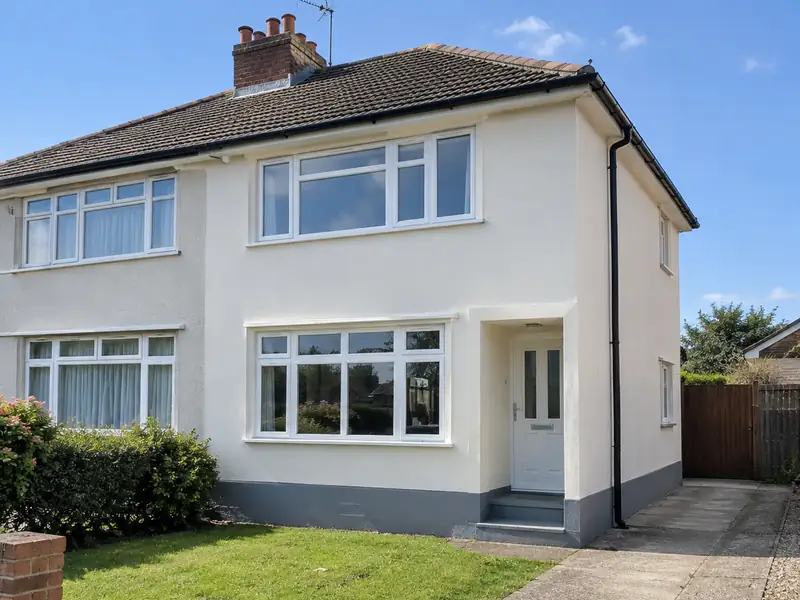
External rendering is applying a protective, weather-resistant coating to the outside walls of a house, using sand and cement, monocouche or thin-coat silicone render, to give a smooth or textured finish that protects the masonry and improves appearance.
Our guide for external rendering in the South West comes to £7,100–£16,500 with VAT added, and that range applies across Devon, including Plymouth, Exeter, Paignton and Torquay. Your own price depends on the size of the job, the specification and how easy it is to work on the site. We survey for free, check any consents needed under the rules in England, and then put the price in writing.
- Guide price
- £7,100–£16,500 inc VAT
- Time on site
- 1–3 weeks on site, depending on weather
- Planning rules
- England
- Price level
- About 2% above the national guide
- Towns listed
- 11
- Survey
- Free, with a written quote
How much does external rendering cost in Devon?
Use the table to gauge the cost of external rendering in Devon before we visit. Figures include VAT and are scaled for the South West, coming out about 2% above the national guide, which gives £7,100–£16,500 overall. After a free survey, you receive a fixed written price.
| Type of job | What it usually involves | Guide in Devon |
|---|---|---|
| Front elevation or small terrace | One elevation or a small terraced house, including scaffolding and preparation. | £3,100–£7,100 |
| Typical semi-detached | All rendered walls of a 3-bed semi in monocouche or silicone, with scaffolding. | £7,100–£16,500 |
| Detached or full strip and re-render | Larger houses, or homes needing old render removed and walls repaired first. | £15,500–£30,500 |
The main things that change the figure:
- Wall area to be rendered and the height of the house
- Removing old render or pebbledash and repairing the walls
- Scaffolding, access and protection of neighbouring property
- Detailing around windows, bays, sills and pipes
Scope of the work
- Survey of walls, existing render, cracks and damp-proof course
- Removal of loose or failed render and pebbledash where needed
- Windows, doors and surfaces masked and protected
- Beads at corners, edges and above the damp-proof course
- Finish coat in your chosen colour and texture
- Making good around pipes, vents and fixings, and a site clean-up
Homes in Devon
Devon is known for cob and thatch cottages, especially in mid and east Devon, alongside granite on Dartmoor and red sandstone around Exeter. Exeter and Plymouth have Georgian and Victorian terraces, Plymouth's centre was largely rebuilt after the war, and seaside towns such as Torquay and Exmouth have rendered villas and newer estates.
Cob and stone homes need breathable lime plaster and render rather than cement. Victorian terraces suit loft rooms and window replacement, while post-war and newer homes often take extensions, rendering and roofline renewal.
Mild but wet, with strong coastal winds; exposed elevations need render and pointing specified for driving rain, and cob walls must be kept dry at the base.
Planning and building rules in Devon
Which rules apply depends on where you live. For Devon, the answer is England, and the points below reflect that; we verify them with the council before quoting.
In England, re-rendering or cladding a house is often allowed without planning permission, but stone, render, timber, plastic or tile cladding is not permitted development in conservation areas, and listed buildings need consent.
If you render or re-clad more than 25% of an external wall, Building Regulations usually require the wall’s insulation to be improved where that is practical, and building control should be notified.
Rules change and every property is different, so we check the planning history and constraints for your address before we quote.
The four stages
A visit to your home
We arrange a free site survey on a date convenient to you. We measure up, look at the existing structure and access, and discuss your plans for external rendering so the price reflects your home.
Written quote
We put everything into a written, fixed-price quote: the specification, what's excluded, staged payments and the expected time on site. Take whatever time you need to decide; there's no pressure to commit.
Plan and prepare
Before anyone starts, we confirm the programme in writing, check whether consents are required and arrange deliveries. If a skip or scaffolding on the road needs a permit, we apply for it.
On site to finish
Work goes ahead as scheduled and you deal with one contact throughout. When the last trade leaves, we clear and clean the site, talk you through what has been done and pass on any certificates and care instructions.
How we work
Questions about external rendering in Devon
What time of year should rendering be done?
Render needs mild, dry conditions to cure properly, so spring to early autumn is ideal. Most render systems should not be applied when frost is likely, in heavy rain or in strong direct sun, which can dry it too quickly and cause cracking. We plan the programme around the forecast and may pause work if the weather turns, which protects the finish.
Can you render over pebbledash or old render?
Rendering over existing pebbledash or render is sometimes possible if it is firmly bonded, but if it sounds hollow, is cracked or is coming away, it must be removed first. Covering failing render simply hides the problem until the new coat fails too. We tap-test the walls and explain whether removal is needed. Removal adds time and cost but gives a sound base.
How long does rendering take?
Rendering a typical semi-detached house takes around one to three weeks. Scaffolding goes up first, then removal of old render, repairs, beads and mesh. Base coats need time to cure before the finish coat. Weather has a big effect, because render should not be applied in rain, frost or strong heat. We give you an expected programme with the quote.
Can I stay at home during the work?
In most cases, yes. Most people can live at home throughout, and we plan the work to keep disruption down by protecting floors, agreeing working hours and keeping access routes clear. Bigger jobs affecting kitchens, bathrooms or heating may mean a short spell with reduced facilities, and we talk this through with you at the survey.
How much will external rendering cost in Devon?
As a guide, expect to pay £7,100–£16,500 including VAT for external rendering in Devon. That range is adjusted for the South West, which runs about 2% above the national guide. Where your project lands depends on size, materials, access and the condition of what is already there. We confirm a fixed price in writing after a free survey of your home.
Towns in Devon
Choose your town from the list to see how we price and plan external rendering in your part of Devon, including typical time on site.