
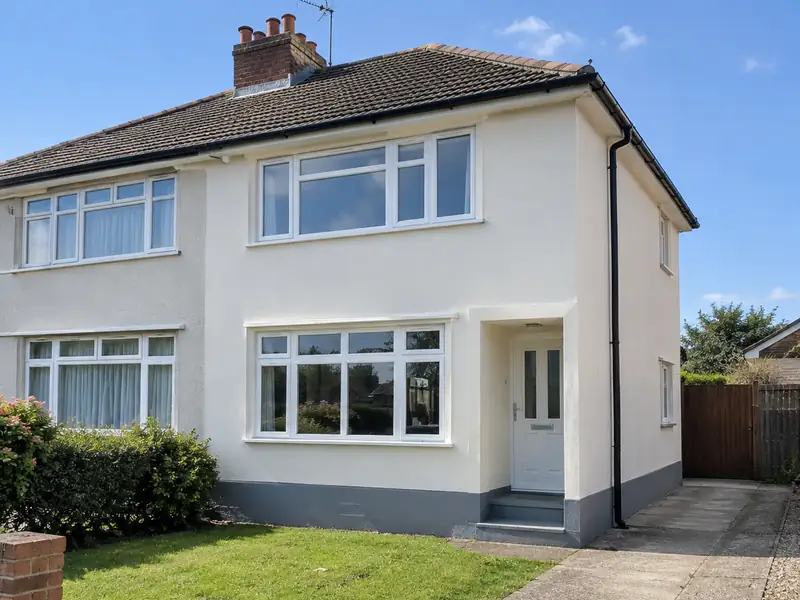
External rendering is applying a protective, weather-resistant coating to the outside walls of a house, using sand and cement, monocouche or thin-coat silicone render, to give a smooth or textured finish that protects the masonry and improves appearance.
Anyone planning external rendering in Newport, Isle of Wight wants three things: a clear price, a realistic timetable and a tidy job. We publish a guide of £7,800–£18,000 including VAT for the South East up front, explain that work normally takes 1–3 weeks on site, depending on weather, and confirm both in writing after a free survey of your property.
- Guide price
- £7,800–£18,000 inc VAT
- Time on site
- 1–3 weeks on site, depending on weather
- Postcodes
- PO30, PO32 and PO33
- Planning rules
- England
- Local area
- Isle of Wight
- Survey
- Free, with a written quote
How much does external rendering cost in Newport, Isle of Wight?
The costs listed here are typical for external rendering around Newport, Isle of Wight and include VAT. They reflect labour and material costs in the South East, about 12% above the national guide, giving a range of £7,800–£18,000. Exact pricing depends on your home, so we only fix it once a free site survey is done.
| Type of job | What it usually involves | Guide in Newport |
|---|---|---|
| Front elevation or small terrace | One elevation or a small terraced house, including scaffolding and preparation. | £3,400–£7,800 |
| Typical semi-detached | All rendered walls of a 3-bed semi in monocouche or silicone, with scaffolding. | £7,800–£18,000 |
| Detached or full strip and re-render | Larger houses, or homes needing old render removed and walls repaired first. | £17,000–£33,500 |
Your price depends mostly on:
- Render system: sand and cement, monocouche or silicone
- Removing old render or pebbledash and repairing the walls
- Scaffolding, access and protection of neighbouring property
- Detailing around windows, bays, sills and pipes
What’s included?
- Survey of walls, existing render, cracks and damp-proof course
- Scaffolding erected and removed, with neighbours' access agreed
- Removal of loose or failed render and pebbledash where needed
- Beads at corners, edges and above the damp-proof course
- Mesh reinforcement and base coats to suit the chosen system
- Finish coat in your chosen colour and texture
Local housing and external rendering
The island has Victorian seaside villas and terraces in Ryde, Ventnor, Shanklin and Cowes, older cottages in island sandstone and limestone, and thatched roofs in some villages. Post-war bungalows, chalets and newer estates are common around Newport and the larger towns.
Salt and wind exposure is high on most coasts, and parts of the south, such as the Undercliff near Ventnor, are known for ground movement.
If your house in Newport, Isle of Wight fits one of these patterns, it helps us anticipate what external rendering will involve, though we always confirm the details on site.
Do you need permission in Newport, Isle of Wight?
The notes below cover England, which is where Newport, Isle of Wight sits. Rules change and every property is different, so we speak to the council before pricing your job.
In England, re-rendering or cladding a house is often allowed without planning permission, but stone, render, timber, plastic or tile cladding is not permitted development in conservation areas, and listed buildings need consent.
If you render or re-clad more than 25% of an external wall, Building Regulations usually require the wall’s insulation to be improved where that is practical, and building control should be notified.
Rules change and every property is different, so we check the planning history and constraints for your address before we quote.
How does the job run?
Free site survey
We arrange a free site survey on a date convenient to you. We measure up, look at the existing structure and access, and discuss your plans for external rendering so the price reflects your home.
Your fixed price
After the survey we send a quote for external rendering that fixes the price for the scope we've agreed. If you want to change materials or scope, we revise it in writing before anything is booked.
Booking the work
We handle the paperwork side: checking whether planning permission or building control approval is needed, submitting applications where they are, and scheduling the trades and materials around your dates.
Finish and handover
The job proceeds in the order set out in the programme, with dust and debris kept under control. Finally we tidy away, inspect the work together and pass the finished project over to you with its paperwork.
Working with SK Home Improvements
External rendering in Newport, Isle of Wight: questions
How much does it cost to render a house?
Rendering a typical 3-bed semi costs £7,800–£18,000, including scaffolding and preparation. As a guide, allow around £60–£120 per square metre of wall plus fixed costs for scaffolding and set-up. Sand and cement is the lowest-cost system, while silicone thin-coat costs more but needs no painting. Removing old render or pebbledash first adds noticeably to the price. We confirm a fixed figure after the survey.
Who do I deal with during the job?
One point of contact manages your project from survey to handover. They schedule the trades working under our contract, keep you updated on progress, and are the person to call with any question. You don't need to coordinate builders, electricians or decorators separately, because that is part of what we do.
How long will external rendering take?
On a typical home, allow 1–3 weeks on site, depending on weather. Larger projects, older buildings and extra work found once things are opened up can extend that, while simpler jobs may be shorter. Your quote includes an estimate of time on site, and your point of contact keeps you updated on the programme as the work progresses.
Will rendering stop damp?
Render protects walls from driving rain, so it can help where rain penetration is the cause of damp. It will not cure rising damp, condensation or leaks from gutters, and on older solid walls the wrong render can trap moisture and make damp worse. We look for the cause of any damp at the survey and recommend fixing that first.
What time of year should rendering be done?
Render needs mild, dry conditions to cure properly, so spring to early autumn is ideal. Most render systems should not be applied when frost is likely, in heavy rain or in strong direct sun, which can dry it too quickly and cause cracking. We plan the programme around the forecast and may pause work if the weather turns, which protects the finish.
Also covering areas around Newport, Isle of Wight
Newport, Isle of Wight and its PO30, PO32 and PO33 postcodes are part of our coverage. Homeowners in Cowes, Ryde and Sandown can also book a free survey with us and receive a written price for their job.