
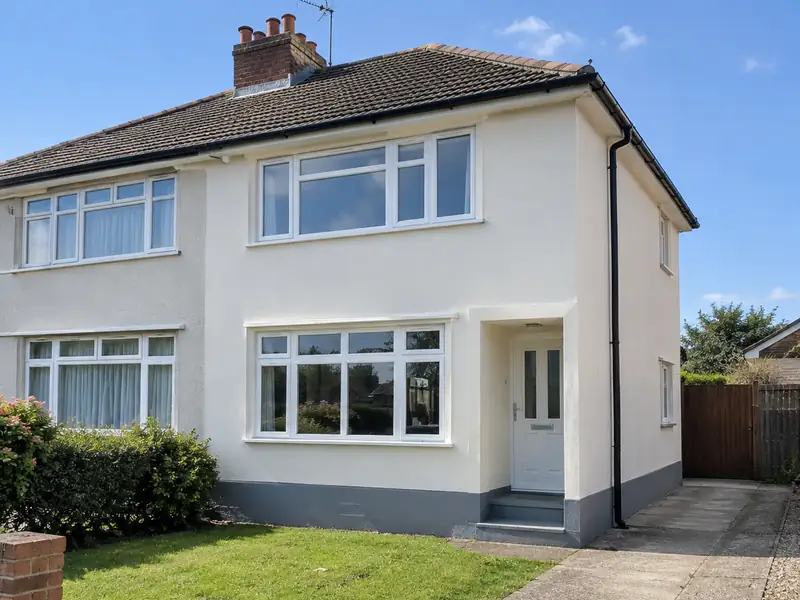
External rendering is applying a protective, weather-resistant coating to the outside walls of a house, using sand and cement, monocouche or thin-coat silicone render, to give a smooth or textured finish that protects the masonry and improves appearance.
Thinking about external rendering in Sunderland? We take charge of the whole project, co-ordinating every trade involved, and one person keeps you updated. Guide prices for the North East sit at £6,300–£14,500 including VAT, and a typical job takes 1–3 weeks on site, depending on weather. Your own figure depends on what the survey finds and the specification you settle on.
- Guide price
- £6,300–£14,500 inc VAT
- Time on site
- 1–3 weeks on site, depending on weather
- Postcodes
- SR1, SR2, SR4, SR5 and SR6
- Planning rules
- England
- Local area
- Tyne and Wear
- Survey
- Free, with a written quote
What should you budget for external rendering in Sunderland?
Prices for external rendering vary from house to house, but in Sunderland most projects fall within £6,300–£14,500 including VAT. That reflects costs in the North East, about 10% below the national guide. Treat the table as a budgeting aid; the written figure follows a survey we carry out for free.
| Type of job | What it usually involves | Guide in Sunderland |
|---|---|---|
| Front elevation or small terrace | One elevation or a small terraced house, including scaffolding and preparation. | £2,700–£6,300 |
| Typical semi-detached | All rendered walls of a 3-bed semi in monocouche or silicone, with scaffolding. | £6,300–£14,500 |
| Detached or full strip and re-render | Larger houses, or homes needing old render removed and walls repaired first. | £13,500–£27,000 |
Your price depends mostly on:
- Wall area to be rendered and the height of the house
- Render system: sand and cement, monocouche or silicone
- Scaffolding, access and protection of neighbouring property
- Detailing around windows, bays, sills and pipes
What do you get?
- Scaffolding erected and removed, with neighbours' access agreed
- Windows, doors and surfaces masked and protected
- Beads at corners, edges and above the damp-proof course
- Mesh reinforcement and base coats to suit the chosen system
- Finish coat in your chosen colour and texture
- Making good around pipes, vents and fixings, and a site clean-up
What are homes like around Sunderland?
Tyneside flats, pairs of upper and lower flats behind a terraced front, are a distinctive feature of Newcastle and Gateshead. Sunderland is known for its single-storey terraced 'Sunderland cottages', and both cities have Victorian brick and stone terraces, interwar estates and post-war housing. Washington was built as a new town from the 1960s.
Cold North Sea winds and sea frets affect the coast at Tynemouth and South Shields, and former coal workings underlie parts of the area.
That variety is why a guide price for external rendering in Sunderland is only a starting point; the survey shows what your particular property needs.
Permissions for external rendering in Sunderland
Each UK nation sets its own consent rules, and Sunderland is in England. What follows is a plain summary; we check the specifics for your property with the council before pricing anything.
In England, re-rendering or cladding a house is often allowed without planning permission, but stone, render, timber, plastic or tile cladding is not permitted development in conservation areas, and listed buildings need consent.
If you render or re-clad more than 25% of an external wall, Building Regulations usually require the wall’s insulation to be improved where that is practical, and building control should be notified.
Rules change and every property is different, so we check the planning history and constraints for your address before we quote.
How does the job run?
We look at the job
We begin by looking at the job in person. During the free survey we discuss options, materials and budget for external rendering, and photograph or measure anything the quote needs to reflect.
Your fixed price
We turn the survey notes into a written quote. The price is fixed for the specification we agree, and the document sets out materials, scope and payment stages in plain language.
Dates and permissions
Once you accept, we agree start dates, order materials and deal with any planning, building control or neighbour notices the job needs. You'll know who is coming and when before work begins.
The work itself
The work is carried out to the agreed specification, with floors and furniture protected and the site kept tidy. At the end we clean up, walk through the finished job with you and hand over any certificates.
How we work
Common questions
Can I stay at home during the work?
In most cases, yes. Most people can live at home throughout, and we plan the work to keep disruption down by protecting floors, agreeing working hours and keeping access routes clear. Bigger jobs affecting kitchens, bathrooms or heating may mean a short spell with reduced facilities, and we talk this through with you at the survey.
Is the price fixed?
Yes, for the specification we agree. Your written quote sets out exactly what is included at a fixed price. It only changes if you ask for something different, or if a problem the survey could not reasonably reveal later needs extra work. In either case we explain the change and confirm it in writing before going ahead.
Which render system should I choose?
The right render depends on your walls and how much upkeep you want. Sand and cement is the lowest-cost option but needs repainting every few years. Monocouche is coloured through, so it needs no painting, and suits block and brick walls. Silicone thin-coat is flexible, water-repellent and stays cleaner, but costs more. Lime render suits older solid walls. We recommend a system after inspecting your walls.
How long does rendering take?
Rendering a typical semi-detached house takes around one to three weeks. Scaffolding goes up first, then removal of old render, repairs, beads and mesh. Base coats need time to cure before the finish coat. Weather has a big effect, because render should not be applied in rain, frost or strong heat. We give you an expected programme with the quote.
What time of year should rendering be done?
Render needs mild, dry conditions to cure properly, so spring to early autumn is ideal. Most render systems should not be applied when frost is likely, in heavy rain or in strong direct sun, which can dry it too quickly and cause cracking. We plan the programme around the forecast and may pause work if the weather turns, which protects the finish.
Near Sunderland
Whether you're in the centre of Sunderland or on its outskirts, SR1, SR2, SR4 and SR5 addresses are covered. We extend the same service, and the same fixed-price approach, to Seaham, Washington and Houghton-Le-Spring.