
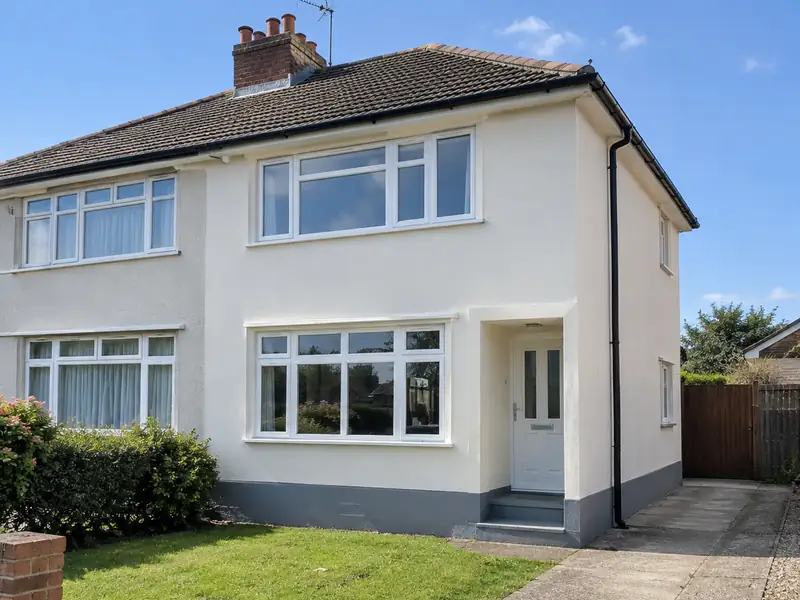
External rendering is applying a protective, weather-resistant coating to the outside walls of a house, using sand and cement, monocouche or thin-coat silicone render, to give a smooth or textured finish that protects the masonry and improves appearance.
We offer external rendering throughout Wiltshire, from Swindon, Salisbury, Trowbridge and Chippenham to the smaller places in between. Each project starts with a free survey at your home and ends with a written figure, fixed for the work you choose. Because Wiltshire is in England, we work to the planning system and building standards used there, and guide prices for the South West run at £7,100–£16,500 including VAT.
- Guide price
- £7,100–£16,500 inc VAT
- Time on site
- 1–3 weeks on site, depending on weather
- Planning rules
- England
- Price level
- About 2% above the national guide
- Towns listed
- 5
- Survey
- Free, with a written quote
How much does external rendering cost in Wiltshire?
What should you budget for external rendering in Wiltshire? Use the figures below as a starting point. Prices in the South West sit about 2% above the national guide, so the range here is £7,100–£16,500 including VAT. Your fixed price comes in writing once we've surveyed the property, at no charge.
| Type of job | What it usually involves | Guide in Wiltshire |
|---|---|---|
| Front elevation or small terrace | One elevation or a small terraced house, including scaffolding and preparation. | £3,100–£7,100 |
| Typical semi-detached | All rendered walls of a 3-bed semi in monocouche or silicone, with scaffolding. | £7,100–£16,500 |
| Detached or full strip and re-render | Larger houses, or homes needing old render removed and walls repaired first. | £15,500–£30,500 |
What moves the price up or down:
- Render system: sand and cement, monocouche or silicone
- Removing old render or pebbledash and repairing the walls
- Scaffolding, access and protection of neighbouring property
- Detailing around windows, bays, sills and pipes
Scope of the work
- Survey of walls, existing render, cracks and damp-proof course
- Scaffolding erected and removed, with neighbours' access agreed
- Removal of loose or failed render and pebbledash where needed
- Beads at corners, edges and above the damp-proof course
- Mesh reinforcement and base coats to suit the chosen system
- Finish coat in your chosen colour and texture
Homes in Wiltshire
Salisbury has medieval and Georgian streets, the north-west around Corsham and Bradford on Avon uses Bath stone, and chalk and flint appear on the downland. Swindon has railway-village terraces and very large post-war and modern estates, and many Wiltshire villages have thatched cottages, some with chalk cob walls.
Cob and Bath stone walls need breathable, lime-based repairs, and thatched cottages may need careful roof work. Swindon's railway terraces suit loft rooms and rear extensions, while its large estates often add garage conversions, driveways and landscaping.
Salisbury Plain and the downs are exposed to wind and frost, while river valleys around Salisbury and the Avon can flood.
Planning and building rules in Wiltshire
The notes below cover England, which is where Wiltshire sits. Rules change and every property is different, so we speak to the council before pricing your job.
In England, re-rendering or cladding a house is often allowed without planning permission, but stone, render, timber, plastic or tile cladding is not permitted development in conservation areas, and listed buildings need consent.
If you render or re-clad more than 25% of an external wall, Building Regulations usually require the wall’s insulation to be improved where that is practical, and building control should be notified.
Rules change and every property is different, so we check the planning history and constraints for your address before we quote.
The four stages
Survey and measure
It starts with a survey at the property, free of charge. We check condition, access and services, ask how you want the finished result to look, and answer any questions you have about external rendering.
Written quote
You get the price in writing, itemised so you can see where the money goes. As long as the specification stays the same, that is the price you pay for external rendering.
Dates and permissions
Next comes planning the work itself. We set a start date that suits you, line up the right trades, and make sure any approvals for external rendering are in place before the first day on site.
On site to finish
Our trades complete external rendering while your point of contact keeps you updated. When everything is finished, we clear the site, take away waste and go through the result with you before handover.
How we work
Frequently asked questions
Do I need planning permission to render my house?
Whether rendering needs planning permission depends on how it changes the appearance, your home's location, whether it is listed or in a conservation area, and which UK nation you are in. Rendering over brick may need permission in some places, while replacing existing render like for like often does not. Listed buildings need consent. We check the position before quoting.
Will rendering stop damp?
Render protects walls from driving rain, so it can help where rain penetration is the cause of damp. It will not cure rising damp, condensation or leaks from gutters, and on older solid walls the wrong render can trap moisture and make damp worse. We look for the cause of any damp at the survey and recommend fixing that first.
Do I need planning permission in Wiltshire?
It depends on the work, the size of the project, your property type and whether the building is listed or in a conservation area. Wiltshire is in England, so England's rules apply. Many smaller jobs need no planning application, but some still need building control approval. We check what applies to your address before quoting.
Which postcodes in Wiltshire do you cover?
We cover SN1, SP1, BA14 and SN15, along with the rest of Wiltshire. If your postcode is not listed, get in touch anyway: our coverage is UK-wide, and we can usually arrange a survey wherever you live. Enter your postcode in the guide-price tool or contact form and we will confirm.
What time of year should rendering be done?
Render needs mild, dry conditions to cure properly, so spring to early autumn is ideal. Most render systems should not be applied when frost is likely, in heavy rain or in strong direct sun, which can dry it too quickly and cause cracking. We plan the programme around the forecast and may pause work if the weather turns, which protects the finish.
Towns in Wiltshire
Our coverage for external rendering in Wiltshire includes the towns listed here. Each page explains guide costs, typical timings and the neighbouring places we also serve.