
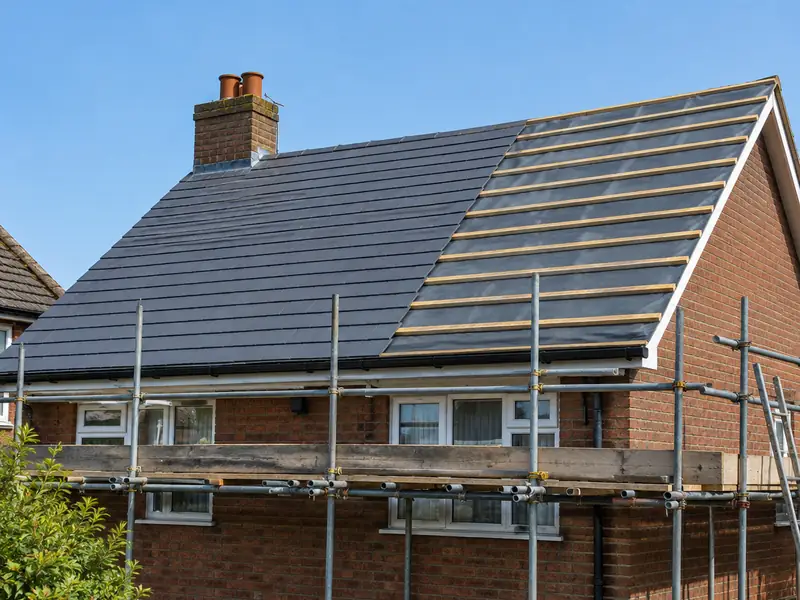
A roof replacement, or re-roof, strips the old tiles or slates, battens and felt from a pitched roof and replaces them with a new breathable membrane, battens and covering, repairing timbers and renewing ridges, valleys and flashings at the same time.
If you are planning a new roof anywhere in Dorset, including Bournemouth, Poole, Weymouth and Christchurch, we can visit, measure up and talk through the options. The planning and building regulations we work to are those for England, and we check them for your address before quoting. Prices remain guide figures for the South West, at £7,100–£15,500 including VAT, until the survey is done.
- Guide price
- £7,100–£15,500 inc VAT
- Time on site
- 1–2 weeks on site, plus scaffolding time
- Planning rules
- England
- Price level
- About 2% above the national guide
- Towns listed
- 4
- Survey
- Free, with a written quote
How much does a new roof cost in Dorset?
Below is a breakdown of typical costs for a new roof in Dorset. Because rates in the South West are about 2% above the national guide, the overall guide comes to £7,100–£15,500, including VAT. Size, materials and access move the figure, and a free-of-charge survey settles it.
| Type of job | What it usually involves | Guide in Dorset |
|---|---|---|
| Terraced house or bungalow | A smaller pitched roof re-covered in concrete or clay tiles, including scaffolding. | £5,100–£10,000 |
| Typical semi-detached | A 3-bed semi re-roofed in concrete or clay tiles with new membrane, battens and leadwork. | £7,100–£15,500 |
| Detached or natural slate | Larger or more complex roofs, or any roof finished in natural slate. | £12,000–£25,500 |
The main things that change the figure:
- Roof area, pitch and the number of hips, valleys and dormers
- Covering material: concrete tile, clay tile or natural slate
- Condition of rafters, fascias and other timbers
- Chimneys, leadwork and roof windows to rework
What’s included?
- Survey of the covering, timbers, chimneys and loft ventilation
- Scaffolding with edge protection, erected and removed
- Stripping old tiles or slates, battens and felt in stages
- Repairs or replacement of damaged rafters and fascia boards
- Breathable membrane and new treated battens
- Waste removal by skip and a clean site on completion
Homes in Dorset
Dorset's older villages use Purbeck and Portland stone, chalk and flint, and thatch on cob or brick cottages. Bournemouth and Poole have Victorian and Edwardian villas, large interwar suburbs and plenty of bungalows and flats, while Weymouth, Dorchester and Bridport mix Georgian and Victorian streets with newer estates.
Stone and thatched cottages may need lime repairs and conservation-area window choices. Bungalows around Bournemouth and Poole commonly suit loft conversions, and coastal homes often need roofline, rendering and window renewal.
Salt spray and south-westerly winds affect coastal homes, so external finishes and fixings need to cope with marine exposure.
Do you need permission in Dorset?
As Dorset is in England, read the following with that system of planning and building control in mind. We check what applies to your house with the council before you receive a quote.
Re-roofing a house with similar materials does not usually need planning permission in England. Listed buildings and conservation areas may need consent if the covering changes.
Replacing more than a quarter of a roof’s covering counts as renovation under Building Regulations, so the work is notified and the roof insulation may need upgrading. Bats are protected across the UK; if they roost under roof tiles, soffits or fascias, work stops and a licensed ecologist advises before it restarts.
Rules change and every property is different, so we check the planning history and constraints for your address before we quote.
How does the job run?
We look at the job
We arrange a free site survey on a date convenient to you. We measure up, look at the existing structure and access, and discuss your plans for a new roof so the price reflects your home.
Written quote
We turn the survey notes into a written quote. The price is fixed for the specification we agree, and the document sets out materials, scope and payment stages in plain language.
Plan and prepare
Before anyone starts, we confirm the programme in writing, check whether consents are required and arrange deliveries. If a skip or scaffolding on the road needs a permit, we apply for it.
Finish and handover
Our trades complete a new roof while your point of contact keeps you updated. When everything is finished, we clear the site, take away waste and go through the result with you before handover.
How we work
Questions about a new roof in Dorset
Will my loft insulation and ventilation be improved?
Re-roofing is a good time to improve loft ventilation and insulation. A breathable membrane and eaves or ridge vents keep air moving and reduce condensation in the loft. Building regulations may require insulation upgrades when a large part of the roof is renewed. We check your current insulation and ventilation and include any required improvements in the quote.
How long does a roof replacement take?
Re-roofing a typical semi-detached house takes around one to two weeks once scaffolding is up, depending on the roof's size, complexity and the weather. Smaller terraced roofs can take a few days. Scaffolding usually goes up a day or two before work starts and comes down once everything is inspected. We give you a programme and keep the roof weathertight overnight.
Can my old tiles or slates be reused?
Old tiles or slates can sometimes be reused if they are sound, which can help keep the look of a period house. Many older concrete tiles and some slates are porous, cracked or have failing fixing nibs, so they would not last. Reclaimed slates or tiles can make up shortfalls. We check a sample during the survey and explain the cost difference.
Can I stay at home during the work?
In most cases, yes. Most people can live at home throughout, and we plan the work to keep disruption down by protecting floors, agreeing working hours and keeping access routes clear. Bigger jobs affecting kitchens, bathrooms or heating may mean a short spell with reduced facilities, and we talk this through with you at the survey.
How long will a new roof take?
On a typical home, allow 1–2 weeks on site, plus scaffolding time. Larger projects, older buildings and extra work found once things are opened up can extend that, while simpler jobs may be shorter. Your quote includes an estimate of time on site, and your point of contact keeps you updated on the programme as the work progresses.
Towns in Dorset
Looking for a new roof somewhere in Dorset? Start with the towns below; each links to a page with pricing for your region and coverage details.