
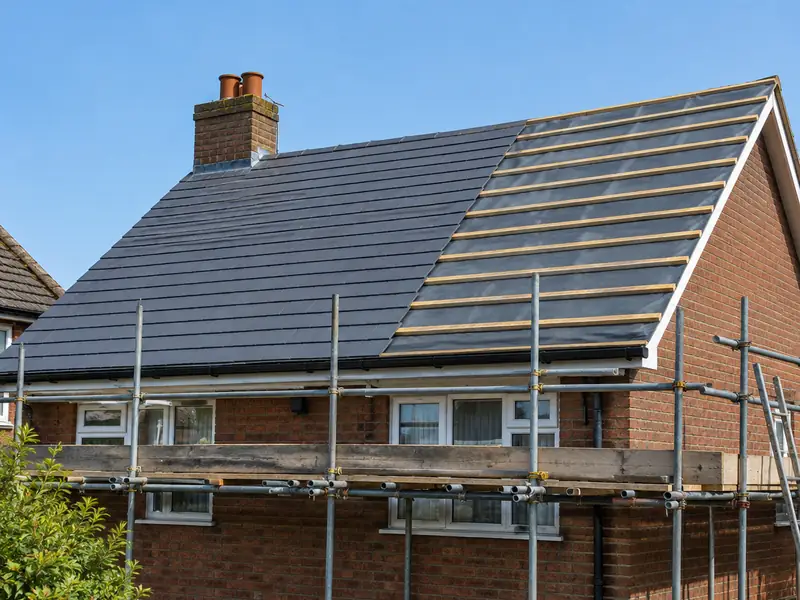
A roof replacement, or re-roof, strips the old tiles or slates, battens and felt from a pitched roof and replaces them with a new breathable membrane, battens and covering, repairing timbers and renewing ridges, valleys and flashings at the same time.
If you live in Leeds and are weighing up a new roof, the starting point is a visit to measure up and talk through what you want, which costs nothing. We cover homes across LS1, LS2, LS3 and LS4, and a typical project of this kind in Yorkshire and the Humber lands somewhere in the £6,600–£14,000 bracket, including VAT. The exact figure depends on size, access and the finish you choose.
- Guide price
- £6,600–£14,000 inc VAT
- Time on site
- 1–2 weeks on site, plus scaffolding time
- Postcodes
- LS1, LS2, LS3, LS4 and LS7
- Planning rules
- England
- Local area
- West Yorkshire
- Survey
- Free, with a written quote
What should you budget for a new roof in Leeds?
Here is how the guide price for a new roof breaks down in Leeds. We start from national figures and adjust for Yorkshire and the Humber, which comes out about 6% below the national guide. The resulting range, VAT included, is £6,600–£14,000, and a survey, at no cost to you, firms it up.
| Type of job | What it usually involves | Guide in Leeds |
|---|---|---|
| Terraced house or bungalow | A smaller pitched roof re-covered in concrete or clay tiles, including scaffolding. | £4,700–£9,400 |
| Typical semi-detached | A 3-bed semi re-roofed in concrete or clay tiles with new membrane, battens and leadwork. | £6,600–£14,000 |
| Detached or natural slate | Larger or more complex roofs, or any roof finished in natural slate. | £11,500–£23,500 |
What moves the price up or down:
- Roof area, pitch and the number of hips, valleys and dormers
- Condition of rafters, fascias and other timbers
- Chimneys, leadwork and roof windows to rework
- Scaffolding, access and the height of the house
What do you get?
- Scaffolding with edge protection, erected and removed
- Stripping old tiles or slates, battens and felt in stages
- Repairs or replacement of damaged rafters and fascia boards
- New tiles or slates, or sound originals refitted where suitable
- Ridges, hips and verges dry-fixed or bedded, with new leadwork
- Waste removal by skip and a clean site on completion
What are homes like around Leeds?
Leeds and Bradford are known for back-to-back and through terraces, many in sandstone or millstone grit, with stone-slate roofs on older properties. Halifax, Huddersfield and the Calder valley have mill-town stone terraces climbing steep hillsides, and interwar semis, post-war estates and newer housing surround the larger towns.
The Pennine hills bring high rainfall, wind and frost, and the Calder valley has a history of serious flooding.
With that background in mind, here is how we typically handle a new roof for homes in Leeds, from the first visit to the finished result.
Planning and building rules in Leeds
The notes below cover England, which is where Leeds sits. Rules change and every property is different, so we speak to the council before pricing your job.
Re-roofing a house with similar materials does not usually need planning permission in England. Listed buildings and conservation areas may need consent if the covering changes.
Replacing more than a quarter of a roof’s covering counts as renovation under Building Regulations, so the work is notified and the roof insulation may need upgrading. Bats are protected across the UK; if they roost under roof tiles, soffits or fascias, work stops and a licensed ecologist advises before it restarts.
Rules change and every property is different, so we check the planning history and constraints for your address before we quote.
From survey to handover
A visit to your home
A free survey comes first. It gives us what we need to price a new roof properly, including dimensions, existing materials and access for deliveries, and gives you the chance to ask anything you like.
Written quote
We put everything into a written, fixed-price quote: the specification, what's excluded, staged payments and the expected time on site. Take whatever time you need to decide; there's no pressure to commit.
Getting ready
Preparation matters as much as the build. We agree access, parking and working hours with you, order materials in good time, and confirm any permissions so the job isn't held up once it starts.
Finish and handover
Work goes ahead as scheduled and you deal with one contact throughout. When the last trade leaves, we clear and clean the site, talk you through what has been done and pass on any certificates and care instructions.
What you can expect from us
Frequently asked questions
Can I stay at home during the work?
In most cases, yes. Most people can live at home throughout, and we plan the work to keep disruption down by protecting floors, agreeing working hours and keeping access routes clear. Bigger jobs affecting kitchens, bathrooms or heating may mean a short spell with reduced facilities, and we talk this through with you at the survey.
What happens at the survey?
We visit your home at a time that suits you, look at the area involved, take measurements and check access, condition and any services that might be affected. We talk through what you want from a new roof, explain the options and answer questions. There is no charge and no obligation; afterwards we send a written quote.
Will my loft insulation and ventilation be improved?
Re-roofing is a good time to improve loft ventilation and insulation. A breathable membrane and eaves or ridge vents keep air moving and reduce condensation in the loft. Building regulations may require insulation upgrades when a large part of the roof is renewed. We check your current insulation and ventilation and include any required improvements in the quote.
What happens if it rains during the work?
We strip the roof in sections and only remove as much covering as we can replace or protect the same day. New breathable membrane goes on straight after stripping, which keeps most rain out, and we sheet exposed areas at the end of each day and before forecast showers. If heavy rain or high winds are forecast, we pause work. The house is never left open.
Can my old tiles or slates be reused?
Old tiles or slates can sometimes be reused if they are sound, which can help keep the look of a period house. Many older concrete tiles and some slates are porous, cracked or have failing fixing nibs, so they would not last. Reclaimed slates or tiles can make up shortfalls. We check a sample during the survey and explain the cost difference.
Near Leeds
We cover every part of Leeds, including LS1, LS2, LS3 and LS4, and nearby Chapel Allerton, Morley and Pudsey. Wherever you are within that patch, the survey is free and the quote comes to you in writing.