
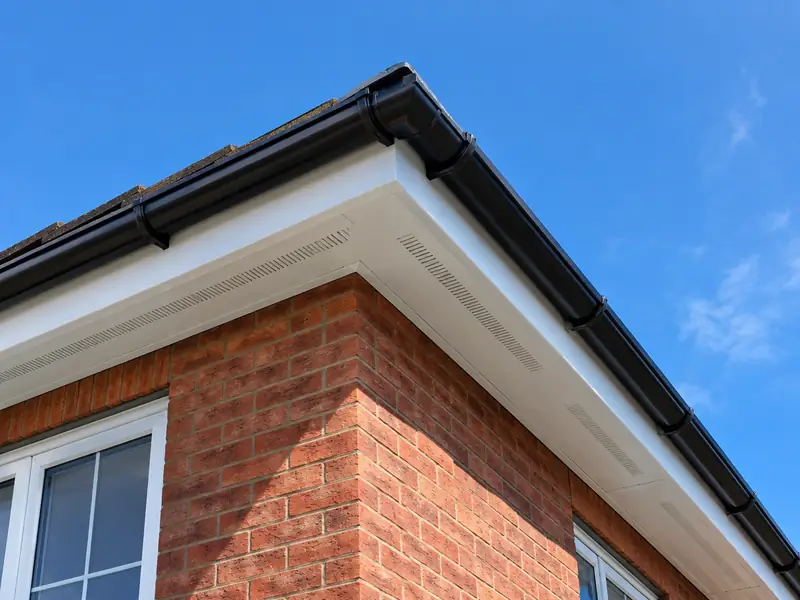
Roofline replacement renews the fascia boards that carry your gutters, the soffits beneath the eaves, bargeboards on gable ends and the gutters and downpipes, usually in low-maintenance uPVC, to protect rafter ends and carry rainwater safely away.
We offer new fascias, soffits and guttering throughout Devon, from Plymouth, Exeter, Paignton and Torquay to the smaller places in between. Each project starts with a free survey at your home and ends with a written figure, fixed for the work you choose. Because Devon is in England, we work to the planning system and building standards used there, and guide prices for the South West run at £2,000–£4,600 including VAT.
- Guide price
- £2,000–£4,600 inc VAT
- Time on site
- 1–3 days for a typical house
- Planning rules
- England
- Price level
- About 2% above the national guide
- Towns listed
- 11
- Survey
- Free, with a written quote
Fascias, soffits and guttering prices in Devon
To help you plan, we show what new fascias, soffits and guttering typically costs in Devon instead of holding figures back for a sales call. The range is £2,000–£4,600 with VAT, using rates in the South West that are about 2% above the national guide. A free survey then fixes your actual price.
| Type of job | What it usually involves | Guide in Devon |
|---|---|---|
| Guttering and downpipes only | New gutters and downpipes on a typical house, where fascias are sound. | £400–£1,550 |
| Full roofline on a semi | Fascias, soffits, gutters and downpipes on the front and rear of a 3-bed semi. | £2,000–£4,600 |
| Detached or with bargeboards | Larger houses, gable bargeboards, dormers or extensive rafter repairs. | £4,100–£8,200 |
What moves the price up or down:
- Length of eaves and number of gable ends
- Colour and finish of the uPVC or metal chosen
- Rafter end repairs found when old boards come off
- Scaffolding and access, including over conservatories
What’s included?
- Survey of boards, rafter ends, gutters and eaves ventilation
- Removal and disposal of old fascias, soffits and gutters
- Repairs to rotten rafter ends and sprockets
- New uPVC fascias, soffits and bargeboards in your chosen colour
- Eaves ventilation and tile support trays fitted
- Downpipes connected to existing drains and the site cleaned
Housing across Devon
Devon is known for cob and thatch cottages, especially in mid and east Devon, alongside granite on Dartmoor and red sandstone around Exeter. Exeter and Plymouth have Georgian and Victorian terraces, Plymouth's centre was largely rebuilt after the war, and seaside towns such as Torquay and Exmouth have rendered villas and newer estates.
Cob and stone homes need breathable lime plaster and render rather than cement. Victorian terraces suit loft rooms and window replacement, while post-war and newer homes often take extensions, rendering and roofline renewal.
Mild but wet, with strong coastal winds; exposed elevations need render and pointing specified for driving rain, and cob walls must be kept dry at the base.
Do you need permission in Devon?
Because Devon falls under England's rules, the guidance below is the version relevant to you. Before sending a price, we check your property's position with the council.
Replacing fascias, soffits and guttering does not need planning permission in England unless the house is listed or a conservation area restricts materials.
Building Regulations do not normally apply to like-for-like roofline replacement. Bats are protected across the UK; if they roost under roof tiles, soffits or fascias, work stops and a licensed ecologist advises before it restarts.
Rules change and every property is different, so we check the planning history and constraints for your address before we quote.
The four stages
We look at the job
First, someone visits your home in Devon to see the space, take measurements and note anything that could affect the work, such as access or the condition of what is there. There is no charge for this visit.
Price and scope agreed
We put everything into a written, fixed-price quote: the specification, what's excluded, staged payments and the expected time on site. Take whatever time you need to decide; there's no pressure to commit.
Dates and permissions
Once you accept, we agree start dates, order materials and deal with any planning, building control or neighbour notices the job needs. You'll know who is coming and when before work begins.
Finish and handover
During the work we protect the areas around it and tidy up at the end of each day. Once complete, we check the finish, remove our materials and hand over paperwork such as building control sign-off where it applies.
How we work
Frequently asked questions
How do I look after uPVC roofline?
uPVC fascias and soffits need little upkeep: wash them once or twice a year with warm soapy water and a soft brush, avoiding solvents and abrasive cleaners. Gutters need clearing at least once a year, usually in late autumn, and more often near trees. Check downpipes are running clear after heavy rain. Gutter guards can reduce how often clearing is needed.
What happens at the survey?
We visit your home at a time that suits you, look at the area involved, take measurements and check access, condition and any services that might be affected. We talk through what you want from new fascias, soffits and guttering, explain the options and answer questions. There is no charge and no obligation; afterwards we send a written quote.
Can you combine new fascias, soffits and guttering with other work?
Yes. Because we manage several trades under one contract, we can plan new fascias, soffits and guttering alongside other work on your Devon home, such as new windows with rendering, or a kitchen refit with an extension. Combining jobs can reduce repeat set-up such as scaffolding, skips and access, and every element is listed and priced in the same written quote.
Should I replace my fascias or just cap them?
Capping, or cladding over old timber fascias with thin uPVC, costs less but traps any rot underneath and hides the condition of the rafter ends. Full replacement removes the old boards so rafter ends can be checked and repaired, and gives a stronger fixing for gutters. We usually recommend full replacement unless the existing timber is genuinely sound.
Why do my gutters overflow?
Gutters usually overflow because they are blocked by leaves, moss or debris, have lost their fall so water sits rather than running to the outlet, or are too small for the roof area. Sagging brackets and failed joints also cause leaks. We check falls, joints and outlet sizes during the survey and may suggest deeper gutters or extra downpipes for large roofs.
Towns in Devon
Choose your town from the list to see how we price and plan new fascias, soffits and guttering in your part of Devon, including typical time on site.