
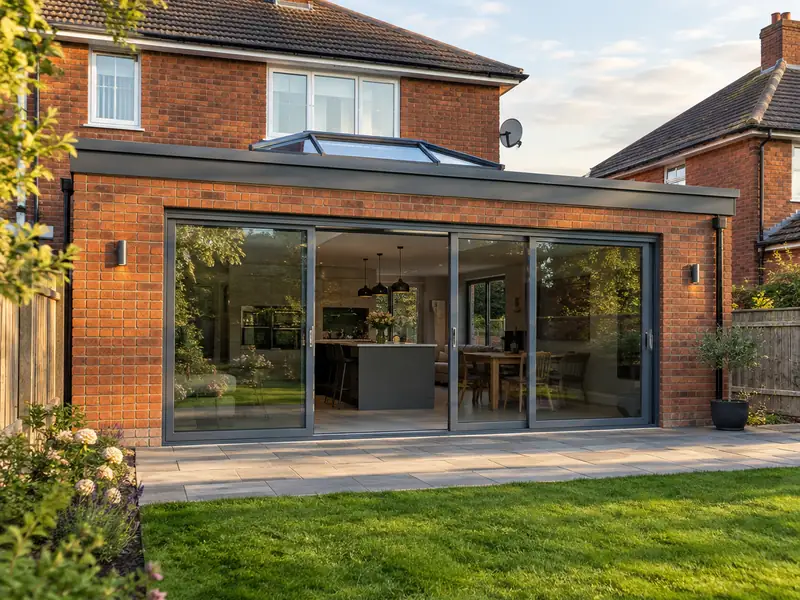
A single-storey extension is a new ground-floor room built onto your house, usually at the rear or side, with its own foundations, walls and roof, creating a bigger kitchen, living space or bedroom without moving home.
Limavady sits within our coverage for a single-storey extension, as do neighbouring Coleraine, Derry/Londonderry and Magherafelt. Before giving a price we want to see the property: the condition of what's there now, the access, and anything that might need extra work. The guide range for Northern Ireland is £30,000–£64,000 including VAT, and your written quote will spell out exactly what that covers.
- Guide price
- £30,000–£64,000 inc VAT
- Time on site
- 10–16 weeks on site
- Postcodes
- BT49
- Planning rules
- Northern Ireland
- Local area
- County Londonderry
- Survey
- Free, with a written quote
What should you budget for a single-storey extension in Limavady?
Use the table to gauge the cost of a single-storey extension in Limavady before we visit. Figures include VAT and are scaled for Northern Ireland, coming out about 14% below the national guide, which gives £30,000–£64,000 overall. After a free survey, you receive a fixed written price.
| Type of job | What it usually involves | Guide in Limavady |
|---|---|---|
| Small extension (8–12m²) | A modest rear or side extension, such as a utility room or a slightly larger kitchen. | £19,000–£34,500 |
| Typical rear extension (15–25m²) | A kitchen-diner or family room with bifold doors and a rooflight or lantern. | £30,000–£64,000 |
| Large or wrap-around (30m² plus) | A wrap-around or wide rear extension, often with structural steelwork into the house. | £60,000–£112,000 |
What moves the price up or down:
- Floor area, shape and number of corners
- Roof type, rooflights, lanterns and the amount of glazing
- Ground conditions, foundation depth and drains to divert
- Finishes, kitchen, flooring and heating specification
What’s included?
- Groundworks, foundations and below-ground drainage
- Cavity walls built and insulated to building regulations
- Flat or pitched roof, with rooflights or a lantern if specified
- Windows and external doors, including bifolds if chosen
- Plastering, screed floor and internal doors
- Building control inspections and completion certificate
What are homes like around Limavady?
Derry has Georgian and Victorian terraces around its walled city, alongside large post-war estates and newer developments. Coleraine, Limavady and Magherafelt mix older town centres with semis and estates, Portstewart has seaside villas, and rural areas have many detached homes and bungalows, often roughcast.
The north coast faces Atlantic wind, rain and salt, and the Sperrins inland are colder and wetter.
Whatever era your Limavady home dates from, we plan a single-storey extension around how it is actually built rather than a one-size-fits-all specification.
Planning and building rules in Limavady
Limavady is in Northern Ireland, so the planning and building rules set out below are the ones that apply. We confirm the details with the council before we quote.
In Northern Ireland, permitted development allows many single-storey rear extensions, typically up to 3 m deep on attached houses and 4 m on detached houses, within height and garden-coverage limits. Conservation areas, listed buildings and side extensions are more restricted.
Building control approval under the Building Regulations (Northern Ireland) is needed for extensions. Northern Ireland has no Party Wall Act, so boundary work is agreed with neighbours directly.
Rules change and every property is different, so we check the planning history and constraints for your address before we quote.
How does the job run?
We look at the job
We begin by looking at the job in person. During the free survey we discuss options, materials and budget for a single-storey extension, and photograph or measure anything the quote needs to reflect.
Price and scope agreed
The quote arrives in writing, not over the phone. It covers the full scope, the finishes you've chosen, any exclusions and the payment schedule, with a fixed price tied to that specification.
Booking the work
Before anyone starts, we confirm the programme in writing, check whether consents are required and arrange deliveries. If a skip or scaffolding on the road needs a permit, we apply for it.
The work itself
Our trades complete a single-storey extension while your point of contact keeps you updated. When everything is finished, we clear the site, take away waste and go through the result with you before handover.
How we work
Common questions
What does a typical extension build look like week by week?
A typical single-storey extension follows the same order: clearing the site and digging foundations, building walls up to roof level, then fitting the roof and windows to make it weathertight. Electrics, plumbing, insulation and plastering follow. The last stage is opening into the house, laying the screed and fitting doors and finishes. Building control inspects at key stages, and we book those visits for you.
How much will a single-storey extension cost in Limavady?
As a guide, expect to pay £30,000–£64,000 including VAT for a single-storey extension in Limavady. That range is adjusted for Northern Ireland, which runs about 14% below the national guide. Where your project lands depends on size, materials, access and the condition of what is already there. We confirm a fixed price in writing after a free survey of your home.
Can I stay at home during the work?
In most cases, yes. Most people can live at home throughout, and we plan the work to keep disruption down by protecting floors, agreeing working hours and keeping access routes clear. Bigger jobs affecting kitchens, bathrooms or heating may mean a short spell with reduced facilities, and we talk this through with you at the survey.
Can we stay at home during the build?
Most people stay at home while we build a single-storey extension, because the new structure goes up outside before we break through. The disruptive part is usually the last few weeks, when we open into the house and fit the kitchen. We put up dust screens, keep a safe route through the house and agree a temporary kitchen setup if needed. Water and power are only off for short, planned periods.
What is the Party Wall Act and does it apply to me?
The Party Wall etc. Act 1996 applies in England and Wales only. In England and Wales, it requires you to give notice to neighbours before certain work on or near a shared wall, such as digging foundations within 3m of their building and deeper than its footings. Neighbours can agree or appoint a surveyor. Scotland and Northern Ireland have no equivalent Act, though general rights still apply. We identify whether notices are needed during the survey.
Nearby towns
Coverage for Limavady spans BT49. Close by, Coleraine, Derry/Londonderry and Magherafelt are covered too, and the rest of our UK-wide area follows the same survey-then-quote process from start to finish.