
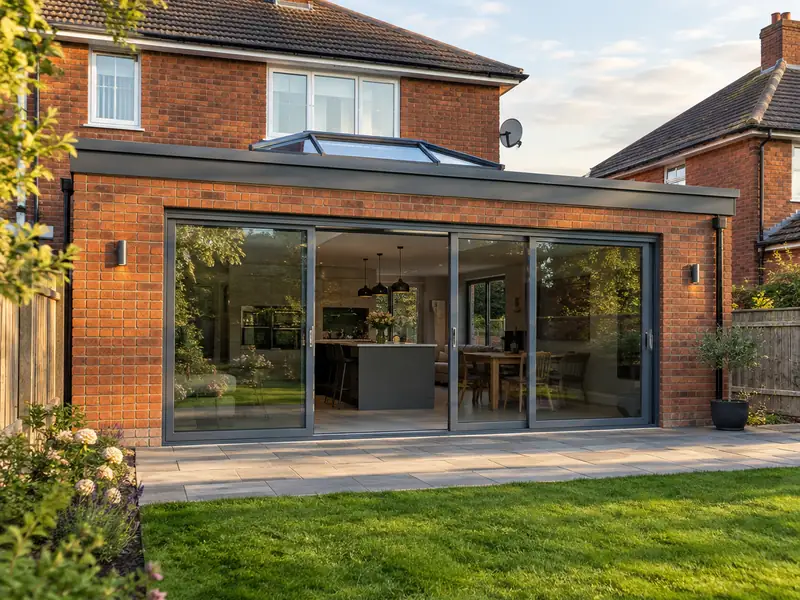
A single-storey extension is a new ground-floor room built onto your house, usually at the rear or side, with its own foundations, walls and roof, creating a bigger kitchen, living space or bedroom without moving home.
We offer a single-storey extension across Mid Glamorgan, and Risca is one of the places we cover, along with nearby Newport, Gwent, Cwmbran and Caerphilly. Before anything is agreed we visit, check the existing structure and talk through your options. You then receive a written quote setting out the full scope; for most homes in Wales it sits within £32,000–£69,000 including VAT.
- Guide price
- £32,000–£69,000 inc VAT
- Time on site
- 10–16 weeks on site
- Postcodes
- NP11
- Planning rules
- Wales
- Local area
- Caerphilly
- Survey
- Free, with a written quote
How much does a single-storey extension cost in Risca?
The costs listed here are typical for a single-storey extension around Risca and include VAT. They reflect labour and material costs in Wales, about 8% below the national guide, giving a range of £32,000–£69,000. Exact pricing depends on your home, so we only fix it once a free site survey is done.
| Type of job | What it usually involves | Guide in Risca |
|---|---|---|
| Small extension (8–12m²) | A modest rear or side extension, such as a utility room or a slightly larger kitchen. | £20,000–£37,000 |
| Typical rear extension (15–25m²) | A kitchen-diner or family room with bifold doors and a rooflight or lantern. | £32,000–£69,000 |
| Large or wrap-around (30m² plus) | A wrap-around or wide rear extension, often with structural steelwork into the house. | £64,000–£120,000 |
The main things that change the figure:
- Floor area, shape and number of corners
- Ground conditions, foundation depth and drains to divert
- Steelwork needed to open into the existing house
- Finishes, kitchen, flooring and heating specification
Scope of the work
- Groundworks, foundations and below-ground drainage
- Flat or pitched roof, with rooflights or a lantern if specified
- Steel beams to open into the existing house
- Electrics and plumbing by qualified trades, with certificates
- Plastering, screed floor and internal doors
- Building control inspections and completion certificate
Local housing and a single-storey extension
The Rhondda, Cynon and Merthyr valleys are lined with stone terraces built for mining families, stepped along steep hillsides. Pontypridd, Caerphilly and Merthyr Tydfil have Victorian centres, and Bridgend has grown with large modern estates alongside interwar and post-war housing.
Valley terraces commonly need repointing, roof repairs, rendering and window replacement, and loft conversions can add useful space. Newer estate homes often take garage conversions, porches and landscaping.
So when we survey a Risca property for a single-storey extension, the first step is working out how it was built and what has been changed since.
Permissions for a single-storey extension in Risca
The notes below cover Wales, which is where Risca sits. Rules change and every property is different, so we speak to the council before pricing your job.
In Wales, permitted development allows many single-storey rear extensions, with depth and height limits that depend on the type of house and how close the extension comes to your boundaries. Side extensions, listed buildings, conservation areas and flats usually need planning permission.
Building Regulations in Wales apply to extensions, from foundations to insulation and fire safety. The Party Wall etc. Act 1996 applies in Wales as it does in England.
Rules change and every property is different, so we check the planning history and constraints for your address before we quote.
What happens after you get in touch?
Survey and measure
A free survey comes first. It gives us what we need to price a single-storey extension properly, including dimensions, existing materials and access for deliveries, and gives you the chance to ask anything you like.
Written quote
Next you receive a written quote with a fixed price for the agreed specification. It lists what is included, what is not, and how payments are staged, so you can compare it properly.
Getting ready
With the quote agreed, we book the work in and handle preparation: permissions where needed, building control notifications, material orders and access arrangements for your Risca property.
Finish and handover
On site, the agreed plan is followed and any change is put in writing first. At completion we do a final clean, go through the snagging list with you and leave you with the relevant documents.
Working with SK Home Improvements
Common questions
Do you cover Newport, Gwent, Cwmbran and Caerphilly?
Yes. As well as Risca, we cover Newport, Gwent, Cwmbran and Caerphilly and the rest of Mid Glamorgan. Our coverage is UK-wide, so the process is the same wherever you are: a free site survey, a quote in writing that fixes the price for the agreed scope, and one point of contact while the work is planned and carried out.
How long does a single-storey extension take to build?
A single-storey extension usually takes 10–16 weeks on site, from digging foundations to final plastering. Bad weather, deep foundations or a complex roof can add time. Before work starts, allow several weeks for drawings, structural calculations and building control approval, and longer if planning permission is needed. We give you a stage-by-stage programme with your quote so you know what happens each week.
Can I stay at home during the work?
In most cases, yes. Most people can live at home throughout, and we plan the work to keep disruption down by protecting floors, agreeing working hours and keeping access routes clear. Bigger jobs affecting kitchens, bathrooms or heating may mean a short spell with reduced facilities, and we talk this through with you at the survey.
Do I need planning permission for a single-storey extension?
Whether you need planning permission depends on the extension's size and height, how close it is to boundaries, your home's location, whether it is listed or in a conservation area, and which UK nation you live in. In England, many rear extensions up to 3m deep on a semi or terrace, or 4m on a detached house, can be built under permitted development. We check the rules that apply to your home before quoting.
What is the Party Wall Act and does it apply to me?
The Party Wall etc. Act 1996 applies in England and Wales only. In England and Wales, it requires you to give notice to neighbours before certain work on or near a shared wall, such as digging foundations within 3m of their building and deeper than its footings. Neighbours can agree or appoint a surveyor. Scotland and Northern Ireland have no equivalent Act, though general rights still apply. We identify whether notices are needed during the survey.
Near Risca
We survey and quote throughout Risca's NP11 postcodes and in surrounding places such as Newport, Gwent, Cwmbran and Caerphilly. The process and pricing approach are identical in each of them.