
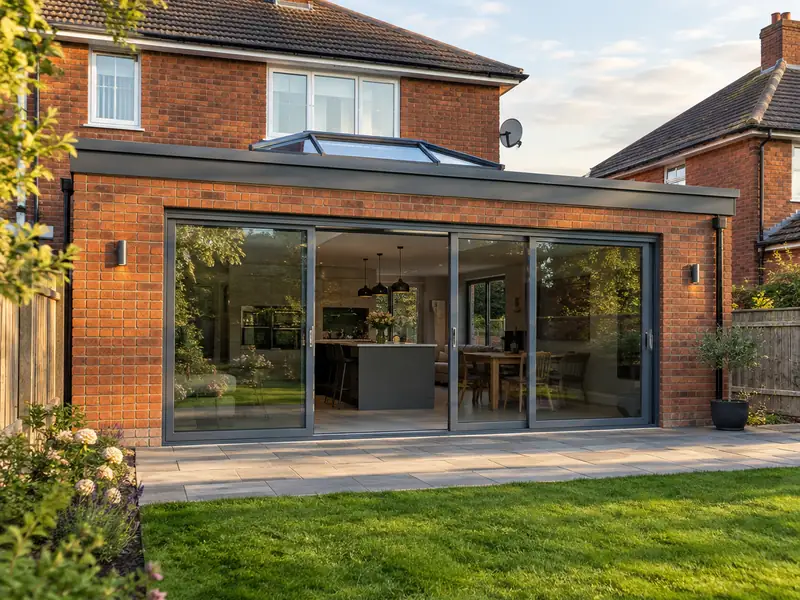
A single-storey extension is a new ground-floor room built onto your house, usually at the rear or side, with its own foundations, walls and roof, creating a bigger kitchen, living space or bedroom without moving home.
Cost is usually the first question about a single-storey extension, so here is the guide for Wales: £32,000–£69,000 including VAT. We cover the whole of Mid Glamorgan, with Rhondda, Tonypandy, Bridgend and Merthyr Tydfil among the main centres. Because each UK nation sets its own rules, we check the requirements in Wales for your property, then put a firm price on paper following a free survey.
- Guide price
- £32,000–£69,000 inc VAT
- Time on site
- 10–16 weeks on site
- Planning rules
- Wales
- Price level
- About 8% below the national guide
- Towns listed
- 12
- Survey
- Free, with a written quote
Single-storey extensions prices in Mid Glamorgan
The table below shows guide prices for a single-storey extension in Mid Glamorgan. They are based on rates in Wales, which run about 8% below the national guide, giving an overall range of £32,000–£69,000. All figures include VAT and are firmed up after a free site survey.
| Type of job | What it usually involves | Guide in Mid Glamorgan |
|---|---|---|
| Small extension (8–12m²) | A modest rear or side extension, such as a utility room or a slightly larger kitchen. | £20,000–£37,000 |
| Typical rear extension (15–25m²) | A kitchen-diner or family room with bifold doors and a rooflight or lantern. | £32,000–£69,000 |
| Large or wrap-around (30m² plus) | A wrap-around or wide rear extension, often with structural steelwork into the house. | £64,000–£120,000 |
What moves the price up or down:
- Floor area, shape and number of corners
- Roof type, rooflights, lanterns and the amount of glazing
- Ground conditions, foundation depth and drains to divert
- Finishes, kitchen, flooring and heating specification
Scope of the work
- Groundworks, foundations and below-ground drainage
- Flat or pitched roof, with rooflights or a lantern if specified
- Steel beams to open into the existing house
- Windows and external doors, including bifolds if chosen
- Plastering, screed floor and internal doors
- Building control inspections and completion certificate
Housing across Mid Glamorgan
The Rhondda, Cynon and Merthyr valleys are lined with stone terraces built for mining families, stepped along steep hillsides. Pontypridd, Caerphilly and Merthyr Tydfil have Victorian centres, and Bridgend has grown with large modern estates alongside interwar and post-war housing.
Valley terraces commonly need repointing, roof repairs, rendering and window replacement, and loft conversions can add useful space. Newer estate homes often take garage conversions, porches and landscaping.
The valleys get heavy rainfall and steep, sloping sites are common, so drainage, retaining walls and render specification matter.
Do you need permission in Mid Glamorgan?
Which rules apply depends on where you live. For Mid Glamorgan, the answer is Wales, and the points below reflect that; we verify them with the council before quoting.
In Wales, permitted development allows many single-storey rear extensions, with depth and height limits that depend on the type of house and how close the extension comes to your boundaries. Side extensions, listed buildings, conservation areas and flats usually need planning permission.
Building Regulations in Wales apply to extensions, from foundations to insulation and fire safety. The Party Wall etc. Act 1996 applies in Wales as it does in England.
Rules change and every property is different, so we check the planning history and constraints for your address before we quote.
How does the job run?
Survey and measure
Book a visit and we'll come to you. The survey covers measurements, the state of what's there now and any obvious constraints, so the price that follows is based on your actual home, not an average.
Price and scope agreed
You get the price in writing, itemised so you can see where the money goes. As long as the specification stays the same, that is the price you pay for a single-storey extension.
Dates and permissions
Next comes planning the work itself. We set a start date that suits you, line up the right trades, and make sure any approvals for a single-storey extension are in place before the first day on site.
The work itself
Our trades complete a single-storey extension while your point of contact keeps you updated. When everything is finished, we clear the site, take away waste and go through the result with you before handover.
What you can expect from us
Frequently asked questions
What happens at the survey?
We visit your home at a time that suits you, look at the area involved, take measurements and check access, condition and any services that might be affected. We talk through what you want from a single-storey extension, explain the options and answer questions. There is no charge and no obligation; afterwards we send a written quote.
Is a flat roof or a pitched roof better on an extension?
A flat roof is quicker to build and usually costs less, gives a clean modern look and works well with a roof lantern. A pitched roof matches the main house, sheds water faster and allows a vaulted ceiling, but it costs more and its height can affect neighbours. Modern flat roofs in EPDM rubber or GRP last well when properly detailed. Planning rules on height can also decide the choice.
How long will a single-storey extension take?
On a typical home, allow 10–16 weeks on site. Larger projects, older buildings and extra work found once things are opened up can extend that, while simpler jobs may be shorter. Your quote includes an estimate of time on site, and your point of contact keeps you updated on the programme as the work progresses.
Can we stay at home during the build?
Most people stay at home while we build a single-storey extension, because the new structure goes up outside before we break through. The disruptive part is usually the last few weeks, when we open into the house and fit the kitchen. We put up dust screens, keep a safe route through the house and agree a temporary kitchen setup if needed. Water and power are only off for short, planned periods.
How long does a single-storey extension take to build?
A single-storey extension usually takes 10–16 weeks on site, from digging foundations to final plastering. Bad weather, deep foundations or a complex roof can add time. Before work starts, allow several weeks for drawings, structural calculations and building control approval, and longer if planning permission is needed. We give you a stage-by-stage programme with your quote so you know what happens each week.
Towns in Mid Glamorgan
Looking for a single-storey extension somewhere in Mid Glamorgan? Start with the towns below; each links to a page with pricing for your region and coverage details.