
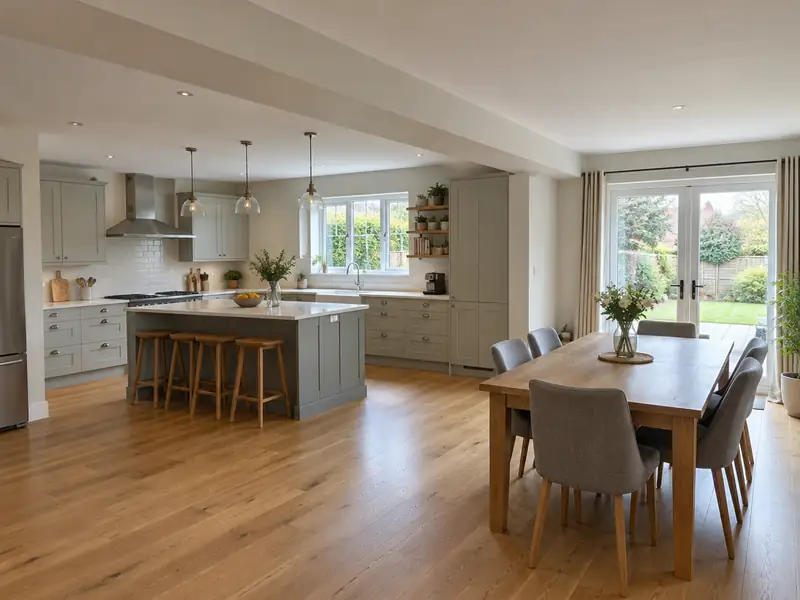
Wall removal is taking out an internal wall to open up rooms; where the wall is load-bearing, a steel beam sized by a structural engineer is installed on padstones to carry the weight above, with the work approved by building control.
Whatever prompted you to look into removing a wall, whether wear and tear, a growing family or plans to move, we can survey your Workington home and give you a price in writing. Homes in the North West typically come in at £2,800–£7,600, VAT included, for this kind of work. We also cover Whitehaven, Annan and Dumfries, and the same steps apply wherever you are in Cumbria.
- Guide price
- £2,800–£7,600 inc VAT
- Time on site
- 1–3 weeks including making good
- Postcodes
- CA14
- Planning rules
- England
- Local area
- Cumbria
- Survey
- Free, with a written quote
How much does removing a wall cost in Workington?
Below is a breakdown of typical costs for removing a wall in Workington. Because rates in the North West are about 5% below the national guide, the overall guide comes to £2,800–£7,600, including VAT. Size, materials and access move the figure, and a free-of-charge survey settles it.
| Type of job | What it usually involves | Guide in Workington |
|---|---|---|
| Non-load-bearing wall | Removing a stud or block partition and making good walls, ceiling and floor. | £750–£1,900 |
| Load-bearing wall up to 4m | A typical kitchen-diner knock-through with one steel beam, calculations and building control. | £2,800–£7,600 |
| Wide or complex opening | Openings over 4m, posts, flush beams or chimney breast removal. | £7,600–£15,000 |
Expect these to shape the final quote:
- Opening width and the load the wall carries
- Beam size, posts, flush fixing and padstone details
- Services in the wall that need rerouting
- Floor and ceiling repairs where the wall stood
What do you get?
- Survey to establish what the wall supports and where loads go
- Structural engineer's calculations and beam specification
- Building control application and inspections
- Temporary propping and dust protection during the work
- Steel beam installed on padstones and packed tight
- Beam boarded or treated for fire protection
Homes in Cumbria
Lake District villages are built largely of slate and rubble stone, often finished in roughcast or limewash, under slate roofs. Kendal is known for grey limestone and Penrith for red sandstone, Carlisle has sandstone and brick terraces, and west coast towns such as Barrow, Workington and Whitehaven have Victorian industrial terraces and post-war estates.
Cumbria is among the wettest parts of England, and high ground and west-facing coasts see severe wind-driven rain, so exposure ratings matter for render and pointing.
With that background in mind, here is how we typically handle removing a wall for homes in Workington, from the first visit to the finished result.
Planning and building rules in Workington
Planning law differs across the UK. For a home in Workington, it is the England rules below that count, and we check them with the council ahead of any quote.
Removing an internal wall does not need planning permission in England unless the house is listed.
If the wall is load-bearing, Building Regulations approval is needed, with a structural engineer’s calculations for the steel beam and padstones. Where the beam bears on a shared wall, the Party Wall etc. Act 1996 applies.
Rules change and every property is different, so we check the planning history and constraints for your address before we quote.
The four stages
Survey and measure
First, someone visits your home in Workington to see the space, take measurements and note anything that could affect the work, such as access or the condition of what is there. There is no charge for this visit.
Price and scope agreed
After the survey we send a quote for removing a wall that fixes the price for the scope we've agreed. If you want to change materials or scope, we revise it in writing before anything is booked.
Dates and permissions
We handle the paperwork side: checking whether planning permission or building control approval is needed, submitting applications where they are, and scheduling the trades and materials around your dates.
Build and hand over
On site, the agreed plan is followed and any change is put in writing first. At completion we do a final clean, go through the snagging list with you and leave you with the relevant documents.
What you can expect from us
Common questions
Which postcodes in Workington do you cover?
We cover CA14, along with the rest of Cumbria. If your postcode is not listed, get in touch anyway: our coverage is UK-wide, and we can usually arrange a survey wherever you live. Enter your postcode in the guide-price tool or contact form and we will confirm.
Do I need planning permission in Workington?
It depends on the work, the size of the project, your property type and whether the building is listed or in a conservation area. Workington is in England, so England's rules apply. Many smaller jobs need no planning application, but some still need building control approval. We check what applies to your address before quoting.
How disruptive is removing a wall?
Removing a wall is dusty and noisy, but the most disruptive part is short, usually one to three days for propping, demolition and installing the steel. We seal doorways with dust screens, protect floors and keep a safe route through the house. Making good, plastering and floor repairs follow over the next week or two. Most people stay at home throughout.
How much does it cost to remove a load-bearing wall?
Removing a load-bearing wall of about 3–4m with a steel beam typically costs £2,800–£7,600, including structural calculations, building control and making good. A non-load-bearing partition costs much less. As a rough guide, allow around £600–£1,600 per metre of opening plus fixed costs for the engineer, approvals and propping. Wider openings, posts and flush beams cost more. We confirm a fixed price after the survey.
What happens to pipes and cables in the wall?
Pipes, cables and radiators in a wall being removed must be rerouted before demolition. Electrical work is done and certified by a qualified electrician, and pipework is diverted by a plumber, usually through the ceiling void or floor. We identify services during the survey and include rerouting in the quote, so there are no surprises once work starts.
Near Workington
Homes across CA14 in Workington are within our coverage, as are those in Whitehaven, Annan and Dumfries. If you are just outside these areas, ask anyway, because we work right across the UK.