
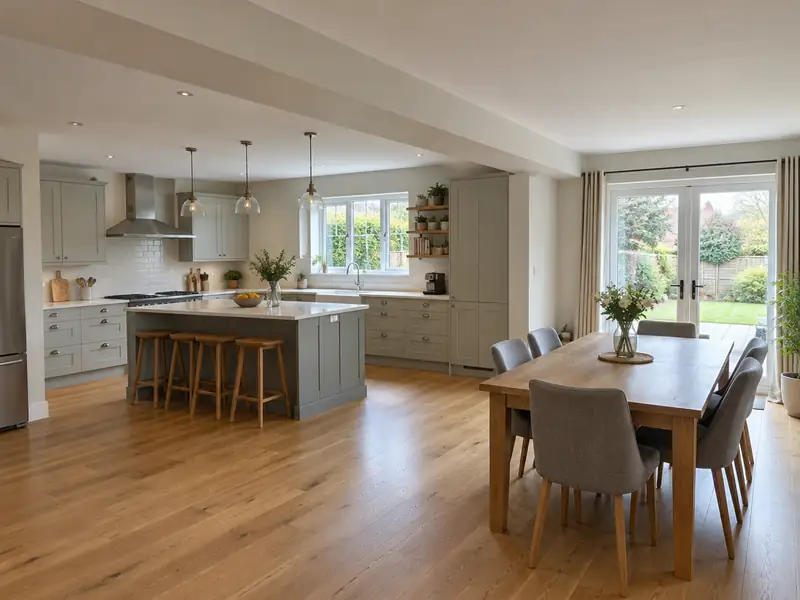
Wall removal is taking out an internal wall to open up rooms; where the wall is load-bearing, a steel beam sized by a structural engineer is installed on padstones to carry the weight above, with the work approved by building control.
Anyone planning removing a wall in Dumfries wants three things: a clear price, a realistic timetable and a tidy job. We publish a guide of £2,900–£7,700 including VAT for Scotland up front, explain that work normally takes 1–3 weeks including making good, and confirm both in writing after a free survey of your property.
- Guide price
- £2,900–£7,700 inc VAT
- Time on site
- 1–3 weeks including making good
- Postcodes
- DG1 and DG2
- Planning rules
- Scotland
- Local area
- Dumfries and Galloway
- Survey
- Free, with a written quote
What should you budget for removing a wall in Dumfries?
Below is a breakdown of typical costs for removing a wall in Dumfries. Because rates in Scotland are about 4% below the national guide, the overall guide comes to £2,900–£7,700, including VAT. Size, materials and access move the figure, and a free-of-charge survey settles it.
| Type of job | What it usually involves | Guide in Dumfries |
|---|---|---|
| Non-load-bearing wall | Removing a stud or block partition and making good walls, ceiling and floor. | £750–£1,900 |
| Load-bearing wall up to 4m | A typical kitchen-diner knock-through with one steel beam, calculations and building control. | £2,900–£7,700 |
| Wide or complex opening | Openings over 4m, posts, flush beams or chimney breast removal. | £7,700–£15,500 |
Your price depends mostly on:
- Opening width and the load the wall carries
- Beam size, posts, flush fixing and padstone details
- Services in the wall that need rerouting
- Floor and ceiling repairs where the wall stood
What does the job include in Dumfries?
- Survey to establish what the wall supports and where loads go
- Structural engineer's calculations and beam specification
- Building control application and inspections
- Temporary propping and dust protection during the work
- Wall taken down and waste removed from site
- Plastering, flooring repairs and making good ready for decorating
Building in Dumfries
Dumfries is known for red sandstone buildings, and older towns across the region, such as Kirkcudbright and Castle Douglas, have Georgian and Victorian streets. Rural homes are often harled whinstone or sandstone farmhouses and cottages under slate roofs, with post-war and modern housing on the edges of towns such as Stranraer and Annan.
Stone and harled homes commonly need lime-based repairs, re-harling and roof slating work. Town houses suit extensions and loft conversions, and rural properties often take porches, driveways and fencing.
These patterns matter for removing a wall: older walls, roofs and floors in Dumfries can need different materials or extra preparation compared with newer homes.
Permissions for removing a wall in Dumfries
The notes below cover Scotland, which is where Dumfries sits. Rules change and every property is different, so we speak to the council before pricing your job.
Removing an internal wall does not need planning permission in Scotland unless the building is listed.
Removing a load-bearing wall needs a building warrant and a structural engineer’s design. In tenement flats, the common parts and other owners’ interests also have to be considered.
Rules change and every property is different, so we check the planning history and constraints for your address before we quote.
From survey to handover
We look at the job
We begin by looking at the job in person. During the free survey we discuss options, materials and budget for removing a wall, and photograph or measure anything the quote needs to reflect.
Quote in writing
You get the price in writing, itemised so you can see where the money goes. As long as the specification stays the same, that is the price you pay for removing a wall.
Dates and permissions
Before anyone starts, we confirm the programme in writing, check whether consents are required and arrange deliveries. If a skip or scaffolding on the road needs a permit, we apply for it.
The work itself
Our trades complete removing a wall while your point of contact keeps you updated. When everything is finished, we clear the site, take away waste and go through the result with you before handover.
How we work
Wall removal and steel beams in Dumfries: questions
Which postcodes in Dumfries do you cover?
We cover DG1 and DG2, along with the rest of Dumfries and Galloway. If your postcode is not listed, get in touch anyway: our coverage is UK-wide, and we can usually arrange a survey wherever you live. Enter your postcode in the guide-price tool or contact form and we will confirm.
Can you combine removing a wall with other work?
Yes. Because we manage several trades under one contract, we can plan removing a wall alongside other work on your Dumfries home, such as new windows with rendering, or a kitchen refit with an extension. Combining jobs can reduce repeat set-up such as scaffolding, skips and access, and every element is listed and priced in the same written quote.
What happens to pipes and cables in the wall?
Pipes, cables and radiators in a wall being removed must be rerouted before demolition. Electrical work is done and certified by a qualified electrician, and pipework is diverted by a plumber, usually through the ceiling void or floor. We identify services during the survey and include rerouting in the quote, so there are no surprises once work starts.
What is a steel beam and why is it needed?
A steel beam, often called an RSJ, is a strong steel section installed where a load-bearing wall used to be, so the weight above is carried across the opening to the walls at each end. It sits on padstones that spread the load. The size depends on the span and the load, which a structural engineer calculates. The beam is then boxed in or plastered.
How do I know if a wall is load-bearing?
A wall is load-bearing if it carries weight from above, such as floor joists, another wall, the roof or a chimney. Clues include joists running across the wall rather than alongside it, and walls lined up with walls on the floor above. Brick or block walls are often structural but not always. We check from above and below during the survey, and an engineer confirms the design.
Nearby towns
We survey and quote throughout Dumfries's DG1 and DG2 postcodes and in surrounding places such as Locharbriggs, Annan and Carlisle. The process and pricing approach are identical in each of them.