
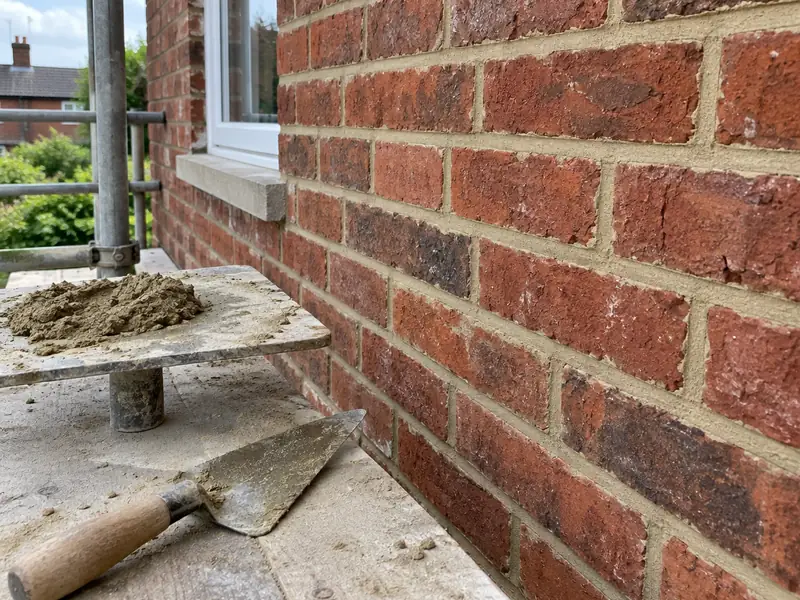
Repointing is raking out old, crumbling mortar from between bricks and replacing it with fresh mortar, sealing the joints against rain and protecting the wall; brickwork repairs replace spalled or cracked bricks and rebuild damaged sections.
For a homeowner in Cambridge, planning brickwork and repointing tends to begin with two questions: what will it cost, and how disruptive will it be? Our guide range is £2,600–£6,300 including VAT, and a typical job runs to 3–10 days for a typical house. Both numbers firm up once we have seen the property, measured up and agreed exactly what is included.
- Guide price
- £2,600–£6,300 inc VAT
- Time on site
- 3–10 days for a typical house
- Postcodes
- CB2
- Planning rules
- England
- Local area
- Cambridgeshire
- Survey
- Free, with a written quote
What should you budget for brickwork and repointing in Cambridge?
To help you plan, we show what brickwork and repointing typically costs in Cambridge instead of holding figures back for a sales call. The range is £2,600–£6,300 with VAT, using rates in the East of England that are about 5% above the national guide. A free survey then fixes your actual price.
| Type of job | What it usually involves | Guide in Cambridge |
|---|---|---|
| Chimney or small area | Repointing a chimney stack, gable or single wall, including access. | £650–£1,900 |
| Typical semi-detached | Repointing the main elevations of a 3-bed semi, including scaffolding. | £2,600–£6,300 |
| Detached or lime work | Larger houses, or period homes repointed in lime with brick repairs. | £5,200–£10,500 |
The main things that change the figure:
- Wall area to repoint and the height of the house
- Number of bricks to replace and how well they match
- Scaffolding and access, including chimneys
- Condition of the existing mortar and how hard it is to remove
What’s included?
- Survey of mortar, bricks, cracks and the cause of any damp
- Scaffolding or access towers where needed
- Raking out old mortar to the correct depth
- Mortar mixed to suit the wall, in lime or cement
- Replacement of spalled or cracked bricks
- Waste removal and a tidy site
Building in Cambridge
Cambridge has many Victorian terraces in pale gault brick, with Edwardian villas and modern estates around the city. Peterborough expanded as a new town from the 1970s, adding large planned estates, while Ely, Huntingdon, St Neots and the Fenland market towns keep Georgian and Victorian centres. Limestone appears in villages near the Northamptonshire border.
This is one of the driest parts of the UK, but open fenland is windy and peat or clay ground can shrink, affecting foundations.
With that background in mind, here is how we typically handle brickwork and repointing for homes in Cambridge, from the first visit to the finished result.
Do you need permission in Cambridge?
Planning law differs across the UK. For a home in Cambridge, it is the England rules below that count, and we check them with the council ahead of any quote.
Repointing and repairing brickwork with matching materials is maintenance, so it does not need planning permission in England. On a listed building, work that affects its character, including a change of mortar or brick, may need listed building consent.
Building Regulations do not normally apply to repointing or brick repairs, but rebuilding a wall, chimney or structural section can need building control involvement.
Rules change and every property is different, so we check the planning history and constraints for your address before we quote.
What happens after you get in touch?
Free site survey
It starts with a survey at the property, free of charge. We check condition, access and services, ask how you want the finished result to look, and answer any questions you have about brickwork and repointing.
Written quote
After the survey we send a quote for brickwork and repointing that fixes the price for the scope we've agreed. If you want to change materials or scope, we revise it in writing before anything is booked.
Dates and permissions
We handle the paperwork side: checking whether planning permission or building control approval is needed, submitting applications where they are, and scheduling the trades and materials around your dates.
Finish and handover
The work is carried out to the agreed specification, with floors and furniture protected and the site kept tidy. At the end we clean up, walk through the finished job with you and hand over any certificates.
What you can expect from us
Questions about brickwork and repointing in Cambridge
Can you match the colour of my existing mortar?
Matching mortar colour is done by choosing the right sand and, where needed, adding pigment or using a coloured lime. We make test panels and let them dry, because mortar looks darker when wet. The joint style, such as flush, bucket handle or weatherstruck, also affects the look. An exact match is not always possible on old walls, but a careful match blends in well.
Who do I deal with during the job?
One point of contact manages your project from survey to handover. They schedule the trades working under our contract, keep you updated on progress, and are the person to call with any question. You don't need to coordinate builders, electricians or decorators separately, because that is part of what we do.
What causes bricks to crumble?
Bricks usually crumble, or spall, when water gets into them and turns to ice, pushing the face off. This is often caused by hard cement mortar or impermeable paint trapping moisture in soft bricks, or by leaking gutters soaking the wall. Damaged bricks can be cut out and replaced with matching ones, or turned round if the back face is sound. We fix the cause at the same time.
What happens at the survey?
We visit your home at a time that suits you, look at the area involved, take measurements and check access, condition and any services that might be affected. We talk through what you want from brickwork and repointing, explain the options and answer questions. There is no charge and no obligation; afterwards we send a written quote.
Is repointing messy or noisy?
Raking out old mortar is noisy and dusty, especially when power tools are used on hard mortar. We sheet scaffolding to contain dust, keep windows closed nearby and clear up at the end of each day. The noisy phase moves around the house elevation by elevation. Inside, you may notice some dust on windowsills, so it helps to keep windows shut.
Nearby towns
Homes across CB2 in Cambridge are within our coverage, as are those in Newmarket, Ely and Huntingdon. If you are just outside these areas, ask anyway, because we work right across the UK.