
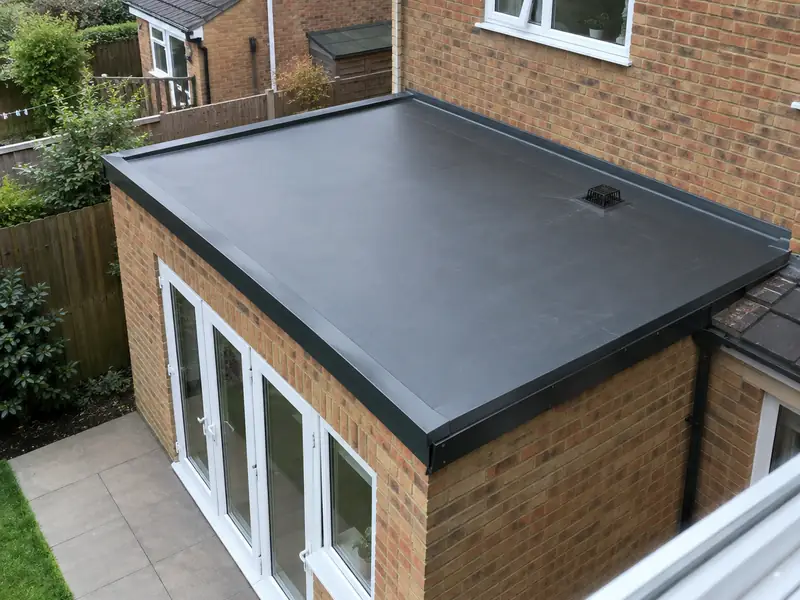
A flat roof replacement strips the old covering from a low-pitched roof and lays a new waterproof system, usually EPDM rubber, GRP fibreglass or torch-on felt, over a sound deck with correct falls, upstands, trims and outlets so rainwater drains away.
We arrange a new flat roof for homeowners in Clydebank and the wider Dunbartonshire. The job is planned, priced and managed by us and carried out by tradespeople engaged under our contract, so there is one agreement and one contact. On a typical home the work takes 1–3 days for most roofs, and guide pricing in Scotland is £1,900–£4,300, VAT included.
- Guide price
- £1,900–£4,300 inc VAT
- Time on site
- 1–3 days for most roofs
- Postcodes
- G60 and G81
- Planning rules
- Scotland
- Local area
- West Dunbartonshire
- Survey
- Free, with a written quote
What should you budget for a new flat roof in Clydebank?
Every figure below is a guide for a new flat roof in Clydebank, inclusive of VAT. Regional pricing for Scotland works out about 4% below the national guide, and the overall span is £1,900–£4,300. The survey costs you nothing, and after it we commit to a firm price for your specification in writing.
| Type of job | What it usually involves | Guide in Clydebank |
|---|---|---|
| Small roof (up to 8m²) | A dormer, bay, porch or small garage roof re-covered in EPDM or GRP. | £750–£1,900 |
| Extension or garage (15–25m²) | A typical extension or single garage roof stripped and re-covered. | £1,900–£4,300 |
| Large or new warm roof | Larger roofs, or roofs needing a new deck and insulation build-up. | £3,800–£8,600 |
What moves the price up or down:
- Roof area and access to the roof
- Condition of the deck and joists underneath
- Insulation upgrades and changes to roof height at edges
- Number of rooflights, pipes and upstands to detail
Scope of the work
- Stripping and disposal of the old roof covering
- Replacement of rotten or soft deck boards
- Insulation upgrade to a warm roof build-up where agreed
- New EPDM, GRP or torch-on felt membrane laid to falls
- Upstands, flashings and drip edges finished neatly
- Rooflights refitted or replaced where required
What are homes like around Clydebank?
Clydebank was heavily rebuilt after wartime bombing and has tenements and post-war estates, while Dumbarton has sandstone tenements and Victorian housing. Bearsden and Milngavie are known for Victorian villas and interwar bungalows, and Kirkintilloch mixes older terraces with post-war semis and newer developments.
Bungalows commonly suit loft conversions with dormers, and villas often take kitchen extensions and landscaping. Tenement flats may need window replacement, and harled homes often need re-rendering.
These patterns matter for a new flat roof: older walls, roofs and floors in Clydebank can need different materials or extra preparation compared with newer homes.
Do you need permission in Clydebank?
Which rules apply depends on where you live. For Clydebank, the answer is Scotland, and the points below reflect that; we verify them with the council before quoting.
In Scotland, like-for-like re-roofing does not usually need planning permission, except on listed buildings or in conservation areas.
Like-for-like re-covering does not usually need a building warrant, but structural changes or new roof windows can. Bats are protected across the UK; if they roost under roof tiles, soffits or fascias, work stops and a licensed ecologist advises before it restarts.
Rules change and every property is different, so we check the planning history and constraints for your address before we quote.
How does the job run?
A visit to your home
It starts with a survey at the property, free of charge. We check condition, access and services, ask how you want the finished result to look, and answer any questions you have about a new flat roof.
Price and scope agreed
The quote arrives in writing, not over the phone. It covers the full scope, the finishes you've chosen, any exclusions and the payment schedule, with a fixed price tied to that specification.
Getting ready
Next comes planning the work itself. We set a start date that suits you, line up the right trades, and make sure any approvals for a new flat roof are in place before the first day on site.
On site to finish
The job proceeds in the order set out in the programme, with dust and debris kept under control. Finally we tidy away, inspect the work together and pass the finished project over to you with its paperwork.
What you can expect from us
Common questions
How long does a flat roof last?
A well-installed EPDM or GRP flat roof can last 25 years or more, while torch-on felt systems typically last around 15–25 years, depending on quality and exposure. Lifespan depends on correct falls, good detailing at edges and upstands, and keeping outlets clear. Foot traffic, ponding and poor ventilation shorten it. Annual checks help catch small problems early.
What happens at the survey?
We visit your home at a time that suits you, look at the area involved, take measurements and check access, condition and any services that might be affected. We talk through what you want from a new flat roof, explain the options and answer questions. There is no charge and no obligation; afterwards we send a written quote.
Is a flat roof suitable for a roof terrace?
A flat roof can only be used as a terrace if it is designed for it, with joists strong enough for people and furniture, a hard-wearing surface, safe edge protection and correct drainage. Using a standard extension roof as a terrace can damage it and may need planning permission and building regulations approval. We can advise on what a conversion would involve.
Is the price fixed?
Yes, for the specification we agree. Your written quote sets out exactly what is included at a fixed price. It only changes if you ask for something different, or if a problem the survey could not reasonably reveal later needs extra work. In either case we explain the change and confirm it in writing before going ahead.
Should I insulate my flat roof when it is replaced?
Replacing a flat roof is the most cost-effective time to add insulation, because the covering is already off. A warm roof, with insulation laid above the deck, keeps the structure warm and reduces condensation risk. Building regulations may require insulation when a large part of the roof is renewed. It raises the roof height slightly, which affects trims and upstands.
Nearby towns
Our coverage in Clydebank includes G60 and G81. We also travel to Erskine, Renfrew and Bearsden, so neighbouring addresses are looked after on exactly the same terms as those in town.