
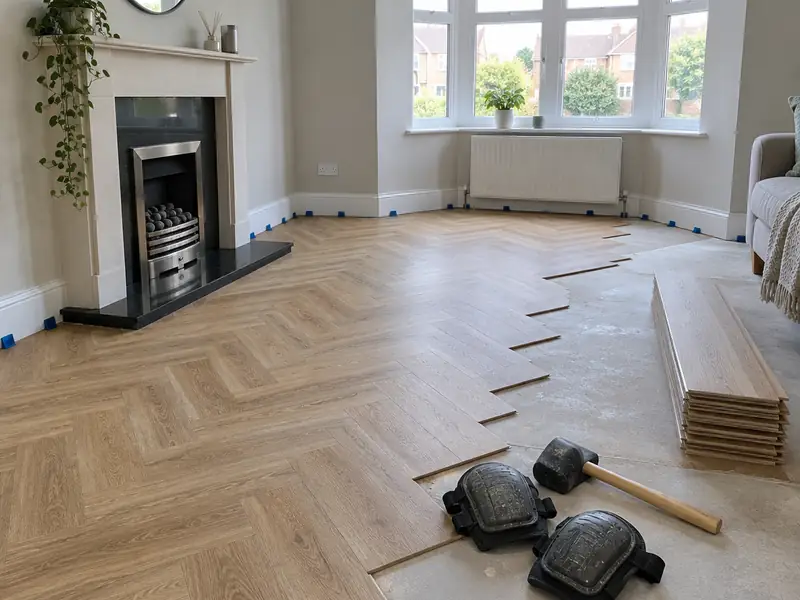
Flooring installation is the supply and fitting of a new floor finish, such as laminate, luxury vinyl tile, engineered wood or solid wood, over a properly levelled and prepared subfloor, with underlay, trims and thresholds finished neatly.
In Berkshire, we price new flooring against our guide for the South East, £1,350–£4,500 including VAT, then adjust it once we have surveyed your home. We work across Reading, Slough, Bracknell and Maidenhead and the rest of the county or region. Planning and building control requirements follow the rules for England, and we look into your property's position before a written quote is sent.
- Guide price
- £1,350–£4,500 inc VAT
- Time on site
- 1–2 days per room, longer if levelling is needed
- Planning rules
- England
- Price level
- About 12% above the national guide
- Towns listed
- 11
- Survey
- Free, with a written quote
How much does new flooring cost in Berkshire?
To help you plan, we show what new flooring typically costs in Berkshire instead of holding figures back for a sales call. The range is £1,350–£4,500 with VAT, using rates in the South East that are about 12% above the national guide. A free survey then fixes your actual price.
| Type of job | What it usually involves | Guide in Berkshire |
|---|---|---|
| Laminate in one room | Around 15–20m² of laminate with underlay, trims and door trimming. | £650–£2,000 |
| LVT or engineered wood | Around 20–25m² of LVT or engineered wood, with levelling and moisture protection. | £1,350–£3,900 |
| Whole floor or solid wood | An open-plan ground floor, solid wood or herringbone, with extensive preparation. | £3,900–£10,000 |
What moves the price up or down:
- Floor area and the number of rooms, stairs and doorways
- Flooring type, plank size and laying pattern
- Lifting and disposing of existing floor coverings
- Underfloor heating, moisture barriers and acoustic underlay
What do you get?
- Measured survey of each room and checks on the subfloor
- Subfloor repairs, levelling compound or plywood overlay where needed
- Damp-proof membrane and suitable underlay for your floor type
- Supply and fitting of your chosen flooring
- Door trimming so doors clear the new floor
- Threshold strips, scotia or skirting finished neatly
Housing across Berkshire
Reading's Victorian terraces often show the town's patterned red and silver-grey brickwork, while Windsor, Maidenhead and Newbury mix Georgian, Victorian and Edwardian houses. Bracknell grew as a post-war new town with planned estates, Slough has a great deal of interwar and post-war housing, and newer developments sit on the edge of most towns.
Period terraces lend themselves to side-return extensions and dormer lofts; post-war and new-town homes often need replacement windows, roofline renewal and extra space. Larger detached houses commonly take on kitchen extensions, bifold doors and landscaping.
Much of the Thames Valley is low-lying, so flood risk and clay ground near the river can influence foundations and drainage for extensions.
Planning and building rules in Berkshire
England, Wales, Scotland and Northern Ireland each handle planning a little differently. Berkshire comes under England, covered below, and we raise any questions with the council before your quote is finalised.
Internal work such as a new kitchen, bathroom, flooring, plastering or decorating does not need planning permission in England, unless the house is listed, when listed building consent may be needed even for internal changes.
Some internal work is covered by Building Regulations: new electrical circuits and work in bathrooms (Part P), new drainage, structural changes, extractor ventilation and any new window. Notifiable work is certified by a registered installer or by building control.
Rules change and every property is different, so we check the planning history and constraints for your address before we quote.
How does the job run?
Free site survey
Book a visit and we'll come to you. The survey covers measurements, the state of what's there now and any obvious constraints, so the price that follows is based on your actual home, not an average.
Quote in writing
You get the price in writing, itemised so you can see where the money goes. As long as the specification stays the same, that is the price you pay for new flooring.
Plan and prepare
Preparation matters as much as the build. We agree access, parking and working hours with you, order materials in good time, and confirm any permissions so the job isn't held up once it starts.
Build and hand over
During the work we protect the areas around it and tidy up at the end of each day. Once complete, we check the finish, remove our materials and hand over paperwork such as building control sign-off where it applies.
How we work
Frequently asked questions
How long does it take to lay a floor?
Laying a floor in an average room usually takes one to two days. Open-plan spaces, herringbone patterns and floors needing levelling compound take longer, because the compound must dry before the floor goes down. Some products also need to acclimatise in the room for a day or two before fitting. We confirm timings for your rooms with the written quote.
Do you cover Reading, Slough and Bracknell?
Yes. As well as Berkshire, we cover Reading, Slough and Bracknell and the rest of Berkshire. Our coverage is UK-wide, so the process is the same wherever you are: a free site survey, a quote in writing that fixes the price for the agreed scope, and one point of contact while the work is planned and carried out.
Which postcodes in Berkshire do you cover?
We cover RG1, SL1, RG12 and SL6, along with the rest of Berkshire. If your postcode is not listed, get in touch anyway: our coverage is UK-wide, and we can usually arrange a survey wherever you live. Enter your postcode in the guide-price tool or contact form and we will confirm.
What preparation does the subfloor need?
A good floor starts with a flat, dry, sound subfloor. Concrete floors may need a damp-proof membrane and levelling compound, while timber floors may need loose boards fixing and a plywood overlay. Old adhesive, tiles or vinyl may have to be removed. Skipping preparation causes creaking, gaps and uneven wear. We check the subfloor at the survey and include preparation in the price.
How do I look after a new floor?
Looking after a new floor is mostly about keeping grit off it, because grit acts like sandpaper. Use doormats, sweep or vacuum regularly and clean with a damp, not wet, mop using a cleaner made for that floor type. Put felt pads under furniture legs. Oiled wood floors need occasional re-oiling, while lacquered wood, laminate and LVT just need regular cleaning.
Towns in Berkshire
Choose your town from the list to see how we price and plan new flooring in your part of Berkshire, including typical time on site.