
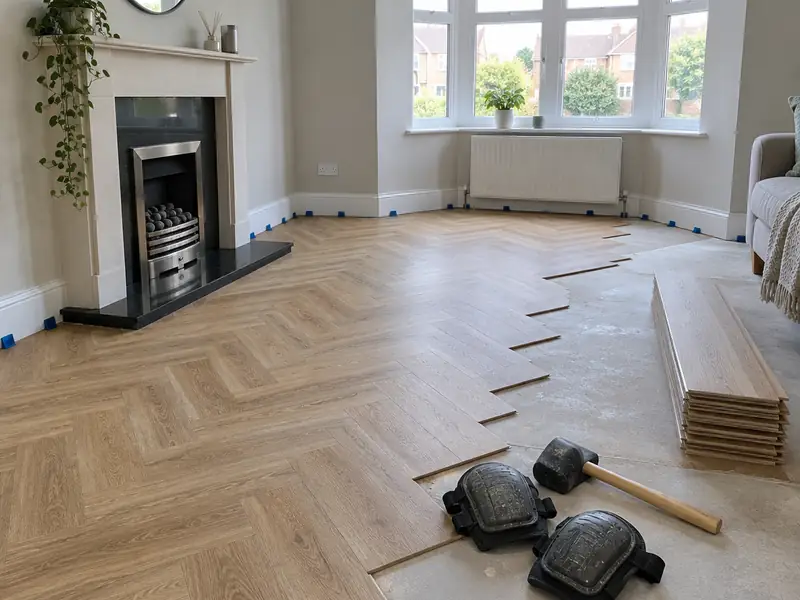
Flooring installation is the supply and fitting of a new floor finish, such as laminate, luxury vinyl tile, engineered wood or solid wood, over a properly levelled and prepared subfloor, with underlay, trims and thresholds finished neatly.
In London, we price new flooring against our guide for London, £1,550–£5,200 including VAT, then adjust it once we have surveyed your home. We work across Brent, Islington, Westminster and Bexley and the rest of the county or region. Planning and building control requirements follow the rules for England, and we look into your property's position before a written quote is sent.
- Guide price
- £1,550–£5,200 inc VAT
- Time on site
- 1–2 days per room, longer if levelling is needed
- Planning rules
- England
- Price level
- About 30% above the national guide
- Towns listed
- 90
- Survey
- Free, with a written quote
How much does new flooring cost in London?
Use the table to gauge the cost of new flooring in London before we visit. Figures include VAT and are scaled for London, coming out about 30% above the national guide, which gives £1,550–£5,200 overall. After a free survey, you receive a fixed written price.
| Type of job | What it usually involves | Guide in London |
|---|---|---|
| Laminate in one room | Around 15–20m² of laminate with underlay, trims and door trimming. | £800–£2,300 |
| LVT or engineered wood | Around 20–25m² of LVT or engineered wood, with levelling and moisture protection. | £1,550–£4,600 |
| Whole floor or solid wood | An open-plan ground floor, solid wood or herringbone, with extensive preparation. | £4,600–£11,500 |
What moves the price up or down:
- Floor area and the number of rooms, stairs and doorways
- Flooring type, plank size and laying pattern
- Lifting and disposing of existing floor coverings
- Underfloor heating, moisture barriers and acoustic underlay
Scope of the work
- Measured survey of each room and checks on the subfloor
- Lifting and disposal of old carpet, laminate or vinyl
- Subfloor repairs, levelling compound or plywood overlay where needed
- Damp-proof membrane and suitable underlay for your floor type
- Supply and fitting of your chosen flooring
- Threshold strips, scotia or skirting finished neatly
Housing across London
London's housing is dominated by Victorian and Edwardian terraces, often in yellow London stock brick, with Georgian terraces in central districts and mansion blocks across many inner areas. Outer boroughs have large belts of interwar semis, and there are extensive post-war council estates. Many houses have been split into flats, and conservation areas are widespread.
Terraces suit side-return extensions and rear dormer loft conversions; interwar semis commonly take hip-to-gable lofts. Shared party walls, restricted parking and conservation rules often shape the plans and the programme.
London Clay shrinks and swells with the seasons, and street trees close to houses can contribute to movement, which affects foundation design.
Planning and building rules in London
As London is in England, read the following with that system of planning and building control in mind. We check what applies to your house with the council before you receive a quote.
Internal work such as a new kitchen, bathroom, flooring, plastering or decorating does not need planning permission in England, unless the house is listed, when listed building consent may be needed even for internal changes.
Some internal work is covered by Building Regulations: new electrical circuits and work in bathrooms (Part P), new drainage, structural changes, extractor ventilation and any new window. Notifiable work is certified by a registered installer or by building control.
Rules change and every property is different, so we check the planning history and constraints for your address before we quote.
The four stages
Free site survey
It starts with a survey at the property, free of charge. We check condition, access and services, ask how you want the finished result to look, and answer any questions you have about new flooring.
Price and scope agreed
After the survey we send a quote for new flooring that fixes the price for the scope we've agreed. If you want to change materials or scope, we revise it in writing before anything is booked.
Plan and prepare
We handle the paperwork side: checking whether planning permission or building control approval is needed, submitting applications where they are, and scheduling the trades and materials around your dates.
The work itself
Work goes ahead as scheduled and you deal with one contact throughout. When the last trade leaves, we clear and clean the site, talk you through what has been done and pass on any certificates and care instructions.
How we work
Frequently asked questions
Which flooring is right for a kitchen or bathroom?
Luxury vinyl tile, or LVT, is usually the most practical choice for kitchens and bathrooms, because it is water-resistant, warm underfoot and comfortable to stand on. Porcelain tiles also suit wet areas. Standard laminate and solid wood can swell if water sits on them, though some water-resistant laminates are available. We recommend a floor based on how the room is used.
What preparation does the subfloor need?
A good floor starts with a flat, dry, sound subfloor. Concrete floors may need a damp-proof membrane and levelling compound, while timber floors may need loose boards fixing and a plywood overlay. Old adhesive, tiles or vinyl may have to be removed. Skipping preparation causes creaking, gaps and uneven wear. We check the subfloor at the survey and include preparation in the price.
How much will new flooring cost in London?
As a guide, expect to pay £1,550–£5,200 including VAT for new flooring in London. That range is adjusted for London, which runs about 30% above the national guide. Where your project lands depends on size, materials, access and the condition of what is already there. We confirm a fixed price in writing after a free survey of your home.
Will my doors need trimming?
Doors often need trimming after new flooring is fitted, because the combined height of the underlay and floor is usually greater than old carpet or vinyl. We take each door off, trim the bottom by the right amount and rehang it so it clears the new floor. Threshold strips are then fitted where the new floor meets another surface.
Can you combine new flooring with other work?
Yes. Because we manage several trades under one contract, we can plan new flooring alongside other work on your London home, such as new windows with rendering, or a kitchen refit with an extension. Combining jobs can reduce repeat set-up such as scaffolding, skips and access, and every element is listed and priced in the same written quote.
Towns in London
These are the towns in London where you can book a free survey for new flooring. Each has its own page with guide prices and coverage details.
- Acton
- Archway
- Barking
- Barnes
- Barnet
- Battersea
- Beckenham
- Becontree
- Bexley
- Blackheath
- Blackwall
- Bow
- Brent
- Brixton
- Camden Town
- Canary Wharf
- Canning Town
- Carshalton
- Catford
- Chalk Farm
- Chelsea
- Chessington
- Chingford
- Chiswick
- Coulsdon
- Cricklewood
- Croydon
- Dagenham
- East Barnet
- Edmonton
- Eltham
- Enfield Town
- Feltham
- Finchley
- Fulham
- Golders Green
- Greenford
- Greenwich
- Hadley Wood
- Hampton
- Hanworth
- Harrow
- Hayes
- Heston
- Highbury
- Holloway
- Hook
- Hornchurch
- Hounslow
- Ilford
- Isleworth
- Islington
- Kilburn
- Leytonstone
- Mitcham
- Morden
- Muswell Hill
- New Malden
- Northolt
- Notting Hill
- Peckham
- Pimlico
- Pinner
- Purley
- Putney
- Richmond
- Romford
- Ruislip
- Shepherds Bush
- Soho
- South Croydon
- Southall
- Stamford Hill
- Stratford
- Streatham
- Surbiton
- Sutton
- Thamesmead
- Tottenham
- Uxbridge
- Wallington
- Walthamstow
- Wealdstone
- Welling
- Wembley
- Westminster
- Willesden
- Wimbledon
- Wood Green
- Woodford Green