
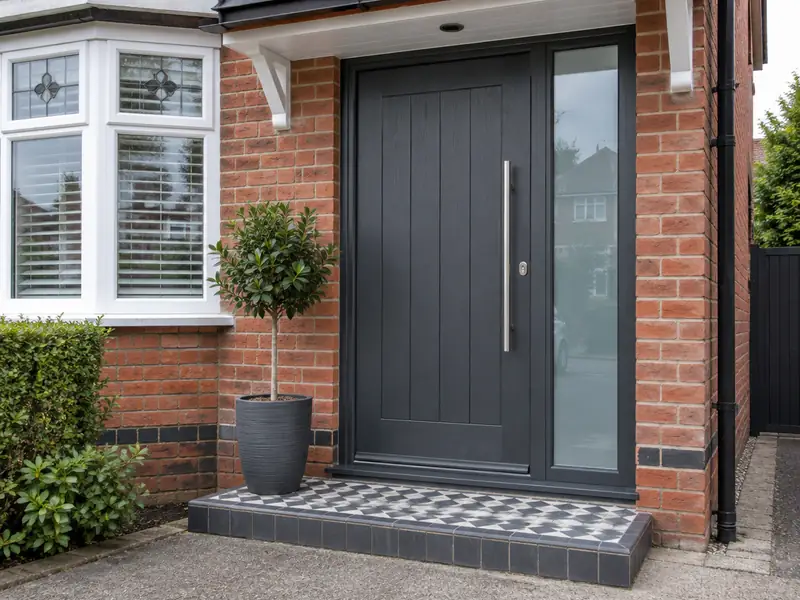
A replacement front or back door is a new door and frame, usually composite, uPVC or aluminium, made to fit your existing opening and fitted with multi-point locks and weather seals to improve security, warmth and kerb appeal.
We offer a new front or back door throughout Suffolk, from Ipswich, Lowestoft, Bury St Edmunds and Haverhill to the smaller places in between. Each project starts with a free survey at your home and ends with a written figure, fixed for the work you choose. Because Suffolk is in England, we work to the planning system and building standards used there, and guide prices for the East of England run at £1,050–£3,700 including VAT.
- Guide price
- £1,050–£3,700 inc VAT
- Time on site
- Usually half a day to one day per door
- Planning rules
- England
- Price level
- About 5% above the national guide
- Towns listed
- 7
- Survey
- Free, with a written quote
Front and back doors prices in Suffolk
To help you plan, we show what a new front or back door typically costs in Suffolk instead of holding figures back for a sales call. The range is £1,050–£3,700 with VAT, using rates in the East of England that are about 5% above the national guide. A free survey then fixes your actual price.
| Type of job | What it usually involves | Guide in Suffolk |
|---|---|---|
| uPVC back door | A standard uPVC back or side door with a half-glazed panel and multi-point lock. | £850–£1,600 |
| Composite front door | A made-to-measure composite door in your chosen colour, glass design and hardware. | £1,250–£2,600 |
| Aluminium or door with side panels | A premium aluminium door, or a composite door with one or two side panels. | £2,600–£5,200 |
What moves the price up or down:
- Door material: uPVC, composite or aluminium
- Side panels, fanlights and the amount of glass
- Lock, cylinder and hardware specification
- Colour, including different colours inside and out
What do you get?
- Measured survey of the opening, threshold and frame condition
- Made-to-measure door and frame in your chosen colour and design
- Multi-point locking with anti-snap cylinders and matching handles
- Low threshold options for level or easier access
- Weather seals, sealant and internal trims finished neatly
- Building regulations paperwork where a glazed door needs it
Housing across Suffolk
Suffolk villages are full of timber-framed cottages, many limewashed in traditional colours such as Suffolk pink, with pargeting and thatch in places. Flint and pale gault brick are common too. Ipswich has Victorian terraces and interwar estates, Bury St Edmunds has Georgian streets, and Lowestoft and Felixstowe mix Victorian seaside housing with newer estates.
Timber-framed buildings need breathable lime plaster and render, and roof repairs that suit the original materials. Terraces suit loft conversions and rear extensions, while newer homes commonly take garage conversions and porches.
One of the driest counties, but the coast is eroding in places, and clay soils inland can shrink and crack in dry summers.
Planning and building rules in Suffolk
Homes in Suffolk come under the regulations for England, summarised below. We don't rely on general rules alone: we confirm the position for your address with the council before a quote goes out.
Replacing windows and doors on a house is usually permitted development in England when the new ones look broadly similar to the old. Flats, listed buildings and homes covered by an Article 4 direction can need consent, and conservation areas may limit materials or styles.
Replacement windows and external doors must meet Building Regulations for energy efficiency, ventilation and, on upper floors, escape. The work is either self-certified by an installer registered with a competent person scheme or signed off by building control.
Rules change and every property is different, so we check the planning history and constraints for your address before we quote.
How does the job run?
We look at the job
Book a visit and we'll come to you. The survey covers measurements, the state of what's there now and any obvious constraints, so the price that follows is based on your actual home, not an average.
Your fixed price
The quote arrives in writing, not over the phone. It covers the full scope, the finishes you've chosen, any exclusions and the payment schedule, with a fixed price tied to that specification.
Dates and permissions
Preparation matters as much as the build. We agree access, parking and working hours with you, order materials in good time, and confirm any permissions so the job isn't held up once it starts.
Build and hand over
Our trades complete a new front or back door while your point of contact keeps you updated. When everything is finished, we clear the site, take away waste and go through the result with you before handover.
How we work
Frequently asked questions
Can I have a low threshold for wheelchair or pushchair access?
A low threshold is a flat or very shallow sill that makes a doorway easier to cross with a wheelchair, walking frame or pushchair. Most composite, uPVC and aluminium doors can be supplied with one. The outside ground level and drainage need checking, because a low threshold must still keep rainwater out. We look at this during the survey and suggest a channel drain or small ramp if needed.
Do I need permission to change my front door?
Planning permission is not usually needed to replace a front door, but it depends on the style and size of the change, your home's location, whether it is listed or in a conservation area, and which UK nation you are in. Listed homes generally need consent for any change, and some conservation areas control colours and styles. Flat entrance doors in shared buildings must also meet fire rules. We check before quoting.
How do I look after a composite or uPVC door?
Looking after a composite or uPVC door is mostly a matter of regular cleaning with warm soapy water and a soft cloth. Avoid solvents and abrasive pads, which can dull the finish. Once or twice a year, lightly oil the lock mechanism and the moving parts along the edge of the door, and check the seals. If the door starts to catch, the hinges can usually be adjusted easily.
Which postcodes in Suffolk do you cover?
We cover IP1, NR32, IP32 and CB9, along with the rest of Suffolk. If your postcode is not listed, get in touch anyway: our coverage is UK-wide, and we can usually arrange a survey wherever you live. Enter your postcode in the guide-price tool or contact form and we will confirm.
What happens at the survey?
We visit your home at a time that suits you, look at the area involved, take measurements and check access, condition and any services that might be affected. We talk through what you want from a new front or back door, explain the options and answer questions. There is no charge and no obligation; afterwards we send a written quote.
Towns in Suffolk
These are the towns in Suffolk where you can book a free survey for a new front or back door. Each has its own page with guide prices and coverage details.