
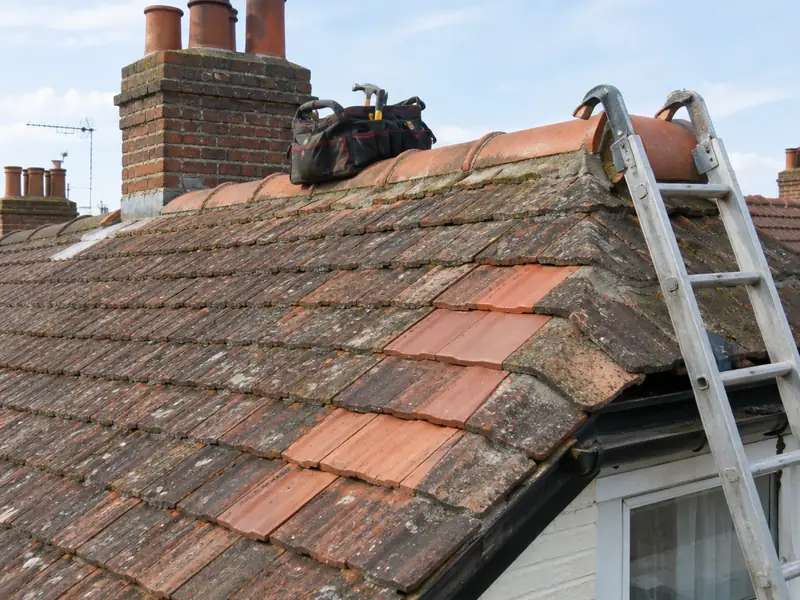
Roof repairs fix specific faults in a pitched or flat roof, such as slipped or cracked tiles, loose ridges, failed flashing, leaking valleys or chimney defects, to stop water getting in without replacing the whole roof.
We offer roof repairs throughout Wiltshire, from Swindon, Salisbury, Trowbridge and Chippenham to the smaller places in between. Each project starts with a free survey at your home and ends with a written figure, fixed for the work you choose. Because Wiltshire is in England, we work to the planning system and building standards used there, and guide prices for the South West run at £300–£1,550 including VAT.
- Guide price
- £300–£1,550 inc VAT
- Time on site
- Half a day to 3 days for most repairs
- Planning rules
- England
- Price level
- About 2% above the national guide
- Towns listed
- 5
- Survey
- Free, with a written quote
How much do roof repairs cost in Wiltshire?
In Wiltshire, guide figures for roof repairs sit at £300–£1,550, VAT included. We set them using rates for the South West, currently about 2% above the national guide. The table shows what pushes a project towards either end of the range; your own price is set after a free survey.
| Type of job | What it usually involves | Guide in Wiltshire |
|---|---|---|
| Minor repair | Replacing a handful of slipped or broken tiles from ladders or a roof ladder. | £200–£500 |
| Ridge, flashing or valley repair | Rebedding a ridge run, renewing flashing or relining a short valley. | £400–£1,200 |
| Larger repair with scaffolding | Several faults, chimney work or repairs on high roofs needing scaffolding. | £1,000–£3,100 |
What moves the price up or down:
- Number and type of faults to repair
- Access: ladders, roof ladders, towers or full scaffolding
- Matching tiles, slates or lead to the existing roof
- Hidden damage to battens, felt or timbers found during repair
What’s included?
- Inspection to trace the source of leaks or damage
- Photos of the problem areas and a clear written explanation
- Safe access by ladders, towers or scaffolding as needed
- Replacement of slipped, cracked or missing tiles and slates
- Lead flashing, valley and chimney junction repairs
- Temporary weatherproofing where a full repair must wait
Housing across Wiltshire
Salisbury has medieval and Georgian streets, the north-west around Corsham and Bradford on Avon uses Bath stone, and chalk and flint appear on the downland. Swindon has railway-village terraces and very large post-war and modern estates, and many Wiltshire villages have thatched cottages, some with chalk cob walls.
Cob and Bath stone walls need breathable, lime-based repairs, and thatched cottages may need careful roof work. Swindon's railway terraces suit loft rooms and rear extensions, while its large estates often add garage conversions, driveways and landscaping.
Salisbury Plain and the downs are exposed to wind and frost, while river valleys around Salisbury and the Avon can flood.
Do you need permission in Wiltshire?
As Wiltshire is in England, read the following with that system of planning and building control in mind. We check what applies to your house with the council before you receive a quote.
Re-roofing a house with similar materials does not usually need planning permission in England. Listed buildings and conservation areas may need consent if the covering changes.
Replacing more than a quarter of a roof’s covering counts as renovation under Building Regulations, so the work is notified and the roof insulation may need upgrading. Bats are protected across the UK; if they roost under roof tiles, soffits or fascias, work stops and a licensed ecologist advises before it restarts.
Rules change and every property is different, so we check the planning history and constraints for your address before we quote.
The four stages
A visit to your home
A free survey comes first. It gives us what we need to price roof repairs properly, including dimensions, existing materials and access for deliveries, and gives you the chance to ask anything you like.
Price and scope agreed
The quote arrives in writing, not over the phone. It covers the full scope, the finishes you've chosen, any exclusions and the payment schedule, with a fixed price tied to that specification.
Booking the work
We handle the paperwork side: checking whether planning permission or building control approval is needed, submitting applications where they are, and scheduling the trades and materials around your dates.
Build and hand over
The job proceeds in the order set out in the programme, with dust and debris kept under control. Finally we tidy away, inspect the work together and pass the finished project over to you with its paperwork.
What you can expect from us
Frequently asked questions
How can I spot roof problems early?
Spotting roof problems early saves money. Look from the ground after storms for slipped or missing tiles, cracked ridge mortar or debris in gutters. In the loft, check for daylight, damp patches, stained timbers or wet insulation. Inside, watch for ceiling stains and peeling paint near outside walls. Clearing gutters each autumn prevents overflow damage.
Who do I deal with during the job?
One point of contact manages your project from survey to handover. They schedule the trades working under our contract, keep you updated on progress, and are the person to call with any question. You don't need to coordinate builders, electricians or decorators separately, because that is part of what we do.
How long will roof repairs take?
On a typical home, allow Half a day to 3 days for most repairs. Larger projects, older buildings and extra work found once things are opened up can extend that, while simpler jobs may be shorter. Your quote includes an estimate of time on site, and your point of contact keeps you updated on the programme as the work progresses.
Is it worth repairing an old roof?
Repairing an old roof is worthwhile when the problem is isolated and the rest of the roof is sound. If tiles are widely porous, battens are rotten or the felt has perished, repeated repairs may cost more over time than a new roof. We look at the overall condition, explain the likely lifespan and give you prices for both where it makes sense.
Can you do an emergency roof repair?
After storm damage, a temporary repair such as sheeting or refixing loose tiles can stop water getting in until a permanent repair can be made. We aim to attend as quickly as possible, but availability depends on weather and demand, especially after widespread storms. In the meantime, catch drips in containers, move valuables and switch off lights near any wet ceiling.
Towns in Wiltshire
Below is our list of Wiltshire towns for roof repairs. If yours isn't shown, we may still cover it, so it is worth asking us directly.