
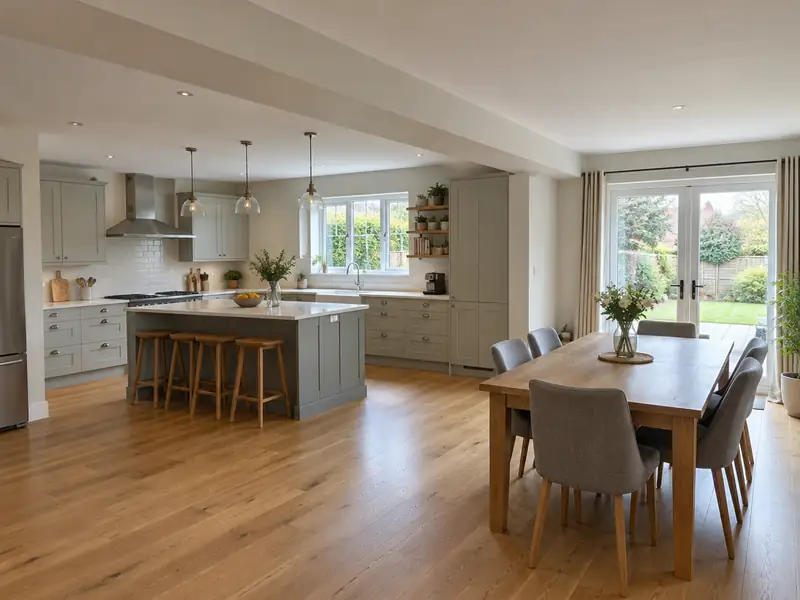
Wall removal is taking out an internal wall to open up rooms; where the wall is load-bearing, a steel beam sized by a structural engineer is installed on padstones to carry the weight above, with the work approved by building control.
For a homeowner in Glenrothes, planning removing a wall tends to begin with two questions: what will it cost, and how disruptive will it be? Our guide range is £2,900–£7,700 including VAT, and a typical job runs to 1–3 weeks including making good. Both numbers firm up once we have seen the property, measured up and agreed exactly what is included.
- Guide price
- £2,900–£7,700 inc VAT
- Time on site
- 1–3 weeks including making good
- Postcodes
- KY6 and KY7
- Planning rules
- Scotland
- Local area
- Fife
- Survey
- Free, with a written quote
Wall removal and steel beams prices in Glenrothes
Below is a breakdown of typical costs for removing a wall in Glenrothes. Because rates in Scotland are about 4% below the national guide, the overall guide comes to £2,900–£7,700, including VAT. Size, materials and access move the figure, and a free-of-charge survey settles it.
| Type of job | What it usually involves | Guide in Glenrothes |
|---|---|---|
| Non-load-bearing wall | Removing a stud or block partition and making good walls, ceiling and floor. | £750–£1,900 |
| Load-bearing wall up to 4m | A typical kitchen-diner knock-through with one steel beam, calculations and building control. | £2,900–£7,700 |
| Wide or complex opening | Openings over 4m, posts, flush beams or chimney breast removal. | £7,700–£15,500 |
Your price depends mostly on:
- Opening width and the load the wall carries
- Services in the wall that need rerouting
- Floor and ceiling repairs where the wall stood
- Engineer, building control and any party wall costs
What’s included?
- Survey to establish what the wall supports and where loads go
- Structural engineer's calculations and beam specification
- Building control application and inspections
- Temporary propping and dust protection during the work
- Wall taken down and waste removed from site
- Plastering, flooring repairs and making good ready for decorating
Homes in Fife
Fife's East Neuk fishing villages are known for pantiled roofs and crow-stepped gables, and St Andrews has historic stone streets. Kirkcaldy and Dunfermline have Victorian sandstone housing and interwar estates, Glenrothes was built as a post-war new town, and former mining towns in central Fife have rows of cottages and post-war council housing.
The coast faces cold easterly winds and salt from the North Sea, and frost is common inland through the winter.
If your house in Glenrothes fits one of these patterns, it helps us anticipate what removing a wall will involve, though we always confirm the details on site.
Do you need permission in Glenrothes?
Because Glenrothes falls under Scotland's rules, the guidance below is the version relevant to you. Before sending a price, we check your property's position with the council.
Removing an internal wall does not need planning permission in Scotland unless the building is listed.
Removing a load-bearing wall needs a building warrant and a structural engineer’s design. In tenement flats, the common parts and other owners’ interests also have to be considered.
Rules change and every property is different, so we check the planning history and constraints for your address before we quote.
The four stages
Free site survey
First, someone visits your home in Glenrothes to see the space, take measurements and note anything that could affect the work, such as access or the condition of what is there. There is no charge for this visit.
Price and scope agreed
After the survey we send a quote for removing a wall that fixes the price for the scope we've agreed. If you want to change materials or scope, we revise it in writing before anything is booked.
Plan and prepare
Next comes planning the work itself. We set a start date that suits you, line up the right trades, and make sure any approvals for removing a wall are in place before the first day on site.
The work itself
During the work we protect the areas around it and tidy up at the end of each day. Once complete, we check the finish, remove our materials and hand over paperwork such as building control sign-off where it applies.
What you can expect from us
Questions about removing a wall in Glenrothes
What is a steel beam and why is it needed?
A steel beam, often called an RSJ, is a strong steel section installed where a load-bearing wall used to be, so the weight above is carried across the opening to the walls at each end. It sits on padstones that spread the load. The size depends on the span and the load, which a structural engineer calculates. The beam is then boxed in or plastered.
Can you combine removing a wall with other work?
Yes. Because we manage several trades under one contract, we can plan removing a wall alongside other work on your Glenrothes home, such as new windows with rendering, or a kitchen refit with an extension. Combining jobs can reduce repeat set-up such as scaffolding, skips and access, and every element is listed and priced in the same written quote.
How do I know if a wall is load-bearing?
A wall is load-bearing if it carries weight from above, such as floor joists, another wall, the roof or a chimney. Clues include joists running across the wall rather than alongside it, and walls lined up with walls on the floor above. Brick or block walls are often structural but not always. We check from above and below during the survey, and an engineer confirms the design.
Does the Party Wall Act apply to wall removal?
The Party Wall etc. Act 1996 applies in England and Wales only. Removing an internal wall usually does not involve it, but if the beam bears into a wall shared with a neighbour, as is common in terraced and semi-detached houses, you must serve notice first. Scotland and Northern Ireland have no equivalent Act. We tell you during the survey whether notices are needed.
Can I stay at home during the work?
In most cases, yes. Most people can live at home throughout, and we plan the work to keep disruption down by protecting floors, agreeing working hours and keeping access routes clear. Bigger jobs affecting kitchens, bathrooms or heating may mean a short spell with reduced facilities, and we talk this through with you at the survey.
Nearby towns
Addresses in KY6 and KY7 are all covered for Glenrothes, along with Kirkcaldy, Dunfermline and Edinburgh close by. Give us your postcode when you get in touch and we will confirm the details.