
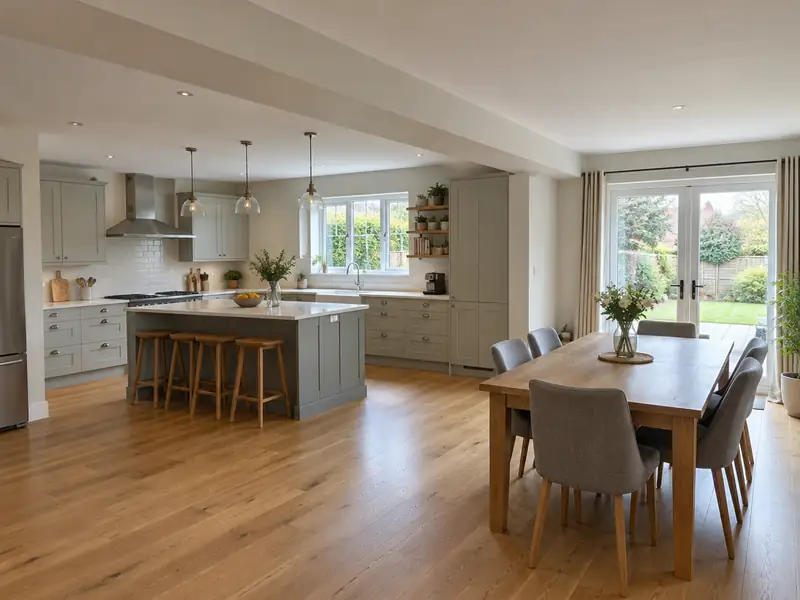
Wall removal is taking out an internal wall to open up rooms; where the wall is load-bearing, a steel beam sized by a structural engineer is installed on padstones to carry the weight above, with the work approved by building control.
Cost is usually the first question about removing a wall, so here is the guide for the South East: £3,400–£9,000 including VAT. We cover the whole of Hampshire, with Southampton, Portsmouth, Basingstoke and Gosport among the main centres. Because each UK nation sets its own rules, we check the requirements in England for your property, then put a firm price on paper following a free survey.
- Guide price
- £3,400–£9,000 inc VAT
- Time on site
- 1–3 weeks including making good
- Planning rules
- England
- Price level
- About 12% above the national guide
- Towns listed
- 20
- Survey
- Free, with a written quote
How much does removing a wall cost in Hampshire?
The table below shows guide prices for removing a wall in Hampshire. They are based on rates in the South East, which run about 12% above the national guide, giving an overall range of £3,400–£9,000. All figures include VAT and are firmed up after a free site survey.
| Type of job | What it usually involves | Guide in Hampshire |
|---|---|---|
| Non-load-bearing wall | Removing a stud or block partition and making good walls, ceiling and floor. | £900–£2,200 |
| Load-bearing wall up to 4m | A typical kitchen-diner knock-through with one steel beam, calculations and building control. | £3,400–£9,000 |
| Wide or complex opening | Openings over 4m, posts, flush beams or chimney breast removal. | £9,000–£18,000 |
The main things that change the figure:
- Opening width and the load the wall carries
- Services in the wall that need rerouting
- Floor and ceiling repairs where the wall stood
- Engineer, building control and any party wall costs
Scope of the work
- Structural engineer's calculations and beam specification
- Building control application and inspections
- Temporary propping and dust protection during the work
- Wall taken down and waste removed from site
- Steel beam installed on padstones and packed tight
- Plastering, flooring repairs and making good ready for decorating
Housing across Hampshire
Southampton and Portsmouth have dense Victorian terraces, with plenty of post-war rebuilding after wartime bombing. Winchester keeps Georgian and medieval streets, Basingstoke expanded rapidly with 1960s and 1970s estates, and New Forest villages feature cob, thatch and brick. Brick and flint is common on the chalk downs, and new estates ring most towns.
Terraces suit loft rooms and side-return extensions; post-war and expanded-town homes often need window, roofline and cladding renewal. Cottages in the Forest may call for lime repairs and planning-sensitive windows.
Coastal areas along the Solent face salt and wind, while chalk downland is better drained but exposed; inland clay can move in dry summers.
Do you need permission in Hampshire?
For anyone in Hampshire, the relevant framework is England's. The summary below is general, so we always contact the council about your address before putting a price in writing.
Removing an internal wall does not need planning permission in England unless the house is listed.
If the wall is load-bearing, Building Regulations approval is needed, with a structural engineer’s calculations for the steel beam and padstones. Where the beam bears on a shared wall, the Party Wall etc. Act 1996 applies.
Rules change and every property is different, so we check the planning history and constraints for your address before we quote.
How does the job run?
Survey and measure
It starts with a survey at the property, free of charge. We check condition, access and services, ask how you want the finished result to look, and answer any questions you have about removing a wall.
Quote in writing
We put everything into a written, fixed-price quote: the specification, what's excluded, staged payments and the expected time on site. Take whatever time you need to decide; there's no pressure to commit.
Dates and permissions
Once you accept, we agree start dates, order materials and deal with any planning, building control or neighbour notices the job needs. You'll know who is coming and when before work begins.
The work itself
The work is carried out to the agreed specification, with floors and furniture protected and the site kept tidy. At the end we clean up, walk through the finished job with you and hand over any certificates.
What you can expect from us
Frequently asked questions
Do I need building regulations approval to remove a wall?
Removing a load-bearing wall needs building regulations approval anywhere in the UK, and in Scotland a building warrant. A structural engineer calculates the beam and supports, and building control inspects the work. Removing a non-structural wall may still need approval if it affects fire escape routes, such as opening a hallway into a living room. We handle the applications and inspections.
What happens at the survey?
We visit your home at a time that suits you, look at the area involved, take measurements and check access, condition and any services that might be affected. We talk through what you want from removing a wall, explain the options and answer questions. There is no charge and no obligation; afterwards we send a written quote.
Can you combine removing a wall with other work?
Yes. Because we manage several trades under one contract, we can plan removing a wall alongside other work on your Hampshire home, such as new windows with rendering, or a kitchen refit with an extension. Combining jobs can reduce repeat set-up such as scaffolding, skips and access, and every element is listed and priced in the same written quote.
Does the Party Wall Act apply to wall removal?
The Party Wall etc. Act 1996 applies in England and Wales only. Removing an internal wall usually does not involve it, but if the beam bears into a wall shared with a neighbour, as is common in terraced and semi-detached houses, you must serve notice first. Scotland and Northern Ireland have no equivalent Act. We tell you during the survey whether notices are needed.
How disruptive is removing a wall?
Removing a wall is dusty and noisy, but the most disruptive part is short, usually one to three days for propping, demolition and installing the steel. We seal doorways with dust screens, protect floors and keep a safe route through the house. Making good, plastering and floor repairs follow over the next week or two. Most people stay at home throughout.
Towns in Hampshire
Homes in all of the following Hampshire towns can get a written quote for removing a wall. Open a town page to see prices and the postcodes we cover.