
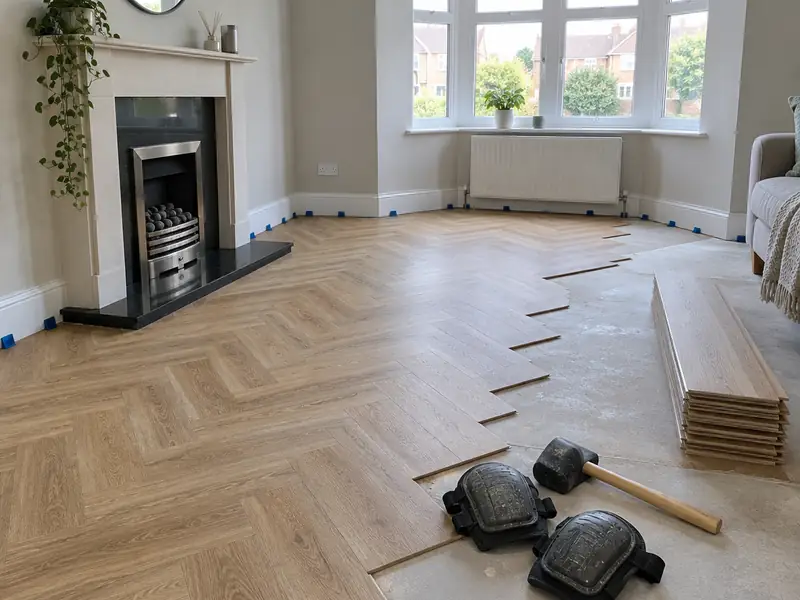
Flooring installation is the supply and fitting of a new floor finish, such as laminate, luxury vinyl tile, engineered wood or solid wood, over a properly levelled and prepared subfloor, with underlay, trims and thresholds finished neatly.
Hull sits within our coverage for new flooring, as do neighbouring Beverley, Brough and Grimsby. Before giving a price we want to see the property: the condition of what's there now, the access, and anything that might need extra work. The guide range for Yorkshire and the Humber is £1,150–£3,800 including VAT, and your written quote will spell out exactly what that covers.
- Guide price
- £1,150–£3,800 inc VAT
- Time on site
- 1–2 days per room, longer if levelling is needed
- Postcodes
- HU1, HU2, HU3, HU5 and HU8
- Planning rules
- England
- Local area
- City of Kingston-upon-Hull
- Survey
- Free, with a written quote
Flooring prices in Hull
The costs listed here are typical for new flooring around Hull and include VAT. They reflect labour and material costs in Yorkshire and the Humber, about 6% below the national guide, giving a range of £1,150–£3,800. Exact pricing depends on your home, so we only fix it once a free site survey is done.
| Type of job | What it usually involves | Guide in Hull |
|---|---|---|
| Laminate in one room | Around 15–20m² of laminate with underlay, trims and door trimming. | £550–£1,700 |
| LVT or engineered wood | Around 20–25m² of LVT or engineered wood, with levelling and moisture protection. | £1,150–£3,300 |
| Whole floor or solid wood | An open-plan ground floor, solid wood or herringbone, with extensive preparation. | £3,300–£8,500 |
Expect these to shape the final quote:
- Floor area and the number of rooms, stairs and doorways
- Flooring type, plank size and laying pattern
- Lifting and disposing of existing floor coverings
- Underfloor heating, moisture barriers and acoustic underlay
What does the job include in Hull?
- Measured survey of each room and checks on the subfloor
- Lifting and disposal of old carpet, laminate or vinyl
- Damp-proof membrane and suitable underlay for your floor type
- Door trimming so doors clear the new floor
- Threshold strips, scotia or skirting finished neatly
- Furniture moved within the room where agreed
Homes in East Riding of Yorkshire
Hull has large areas of Victorian and Edwardian terraces, many arranged in the city's distinctive short cul-de-sac terraces running off the main streets, plus extensive interwar and post-war estates. Beverley keeps Georgian brick houses, Wolds villages use chalk and brick, and red clay pantile roofs are common across the area. Coastal towns such as Bridlington mix guest-house terraces with bungalows.
Terraced homes often suit loft rooms and rear extensions; pantile roofs may need re-roofing with matching tiles. Bungalows commonly benefit from loft conversions, and older brick houses need repointing with a suitable mortar.
That variety is why a guide price for new flooring in Hull is only a starting point; the survey shows what your particular property needs.
Permissions for new flooring in Hull
England, Wales, Scotland and Northern Ireland each handle planning a little differently. Hull comes under England, covered below, and we raise any questions with the council before your quote is finalised.
Internal work such as a new kitchen, bathroom, flooring, plastering or decorating does not need planning permission in England, unless the house is listed, when listed building consent may be needed even for internal changes.
Some internal work is covered by Building Regulations: new electrical circuits and work in bathrooms (Part P), new drainage, structural changes, extractor ventilation and any new window. Notifiable work is certified by a registered installer or by building control.
Rules change and every property is different, so we check the planning history and constraints for your address before we quote.
What happens after you get in touch?
Free site survey
Book a visit and we'll come to you. The survey covers measurements, the state of what's there now and any obvious constraints, so the price that follows is based on your actual home, not an average.
Price and scope agreed
We put everything into a written, fixed-price quote: the specification, what's excluded, staged payments and the expected time on site. Take whatever time you need to decide; there's no pressure to commit.
Getting ready
With the quote agreed, we book the work in and handle preparation: permissions where needed, building control notifications, material orders and access arrangements for your Hull property.
On site to finish
Work goes ahead as scheduled and you deal with one contact throughout. When the last trade leaves, we clear and clean the site, talk you through what has been done and pass on any certificates and care instructions.
Why homeowners choose us
Frequently asked questions
Which flooring is right for a kitchen or bathroom?
Luxury vinyl tile, or LVT, is usually the most practical choice for kitchens and bathrooms, because it is water-resistant, warm underfoot and comfortable to stand on. Porcelain tiles also suit wet areas. Standard laminate and solid wood can swell if water sits on them, though some water-resistant laminates are available. We recommend a floor based on how the room is used.
What do I need to do before the fitters arrive?
Before fitting day, clear small items, ornaments and anything fragile from the room, and empty cupboards and wardrobes that stand on the floor. Let us know about heavy furniture so we can agree who moves it. Make sure the heating is set to a normal temperature so the flooring acclimatises properly. If you have pets, keep them out of the room while we work.
Do I need planning permission in Hull?
It depends on the work, the size of the project, your property type and whether the building is listed or in a conservation area. Hull is in England, so England's rules apply. Many smaller jobs need no planning application, but some still need building control approval. We check what applies to your address before quoting.
Can you combine new flooring with other work?
Yes. Because we manage several trades under one contract, we can plan new flooring alongside other work on your Hull home, such as new windows with rendering, or a kitchen refit with an extension. Combining jobs can reduce repeat set-up such as scaffolding, skips and access, and every element is listed and priced in the same written quote.
How do I look after a new floor?
Looking after a new floor is mostly about keeping grit off it, because grit acts like sandpaper. Use doormats, sweep or vacuum regularly and clean with a damp, not wet, mop using a cleaner made for that floor type. Put felt pads under furniture legs. Oiled wood floors need occasional re-oiling, while lacquered wood, laminate and LVT just need regular cleaning.
Near Hull
Hull and its HU1, HU2, HU3 and HU5 postcodes are part of our coverage. Homeowners in Beverley, Brough and Grimsby can also book a free survey with us and receive a written price for their job.