
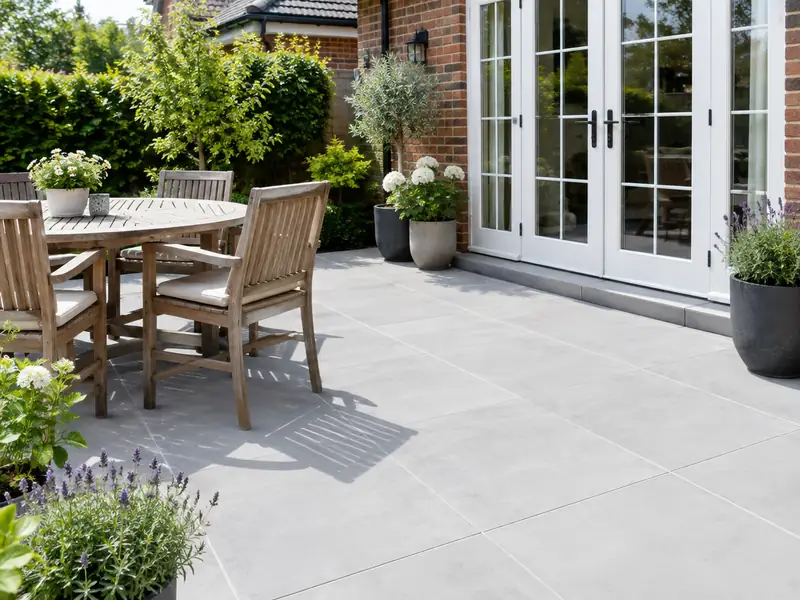
A patio is a paved outdoor area next to the house or in the garden, laid in porcelain, natural stone or concrete slabs on a compacted sub-base and mortar bed, with falls that direct rainwater away from the house.
Anyone planning a new patio in Exeter wants three things: a clear price, a realistic timetable and a tidy job. We publish a guide of £2,600–£5,600 including VAT for the South West up front, explain that work normally takes 3–7 days on site, and confirm both in writing after a free survey of your property.
- Guide price
- £2,600–£5,600 inc VAT
- Time on site
- 3–7 days on site
- Postcodes
- EX1, EX2, EX3 and EX4
- Planning rules
- England
- Local area
- Devon
- Survey
- Free, with a written quote
What should you budget for a new patio in Exeter?
No two jobs cost exactly the same, but the ranges below give a fair picture of a new patio in Exeter. Pricing for the South West runs about 2% above the national guide, and the overall guide is £2,600–£5,600 with VAT included. We'll confirm your figure after surveying the property for free.
| Type of job | What it usually involves | Guide in Exeter |
|---|---|---|
| Small patio or path | Around 10m² of concrete slabs or a garden path. | £1,000–£2,600 |
| Typical 20m² patio | Sandstone or porcelain on a full sub-base with jointing and edging. | £2,600–£5,600 |
| Large or multi-level patio | Bigger areas, steps, retaining walls or premium stone. | £5,600–£12,000 |
What moves the price up or down:
- Patio area and the amount of excavation
- Ground levels, slopes, steps and retaining walls
- Drainage needed to keep water away from the house
- Access for materials and removing spoil
What does the job include in Exeter?
- Survey of levels, damp-proof course, drainage and access
- Excavation and removal of turf, soil or old paving
- Slabs laid on a full mortar bed with falls away from the house
- Primer on porcelain slabs for a strong bond
- Jointing with mortar or a brush-in compound
- Edging and neat cuts around drains and walls
Homes in Devon
Devon is known for cob and thatch cottages, especially in mid and east Devon, alongside granite on Dartmoor and red sandstone around Exeter. Exeter and Plymouth have Georgian and Victorian terraces, Plymouth's centre was largely rebuilt after the war, and seaside towns such as Torquay and Exmouth have rendered villas and newer estates.
Cob and stone homes need breathable lime plaster and render rather than cement. Victorian terraces suit loft rooms and window replacement, while post-war and newer homes often take extensions, rendering and roofline renewal.
That mix of housing shapes how we approach a new patio in Exeter: the age and construction of your home affect the materials, the method and, in the end, the price.
Planning and building rules in Exeter
Which rules apply depends on where you live. For Exeter, the answer is England, and the points below reflect that; we verify them with the council before quoting.
A ground-level patio in a back garden does not usually need planning permission in England. Raised decks or platforms more than 30 cm high do.
Building Regulations do not normally apply to patios, but levels must stay below the damp-proof course and drain away from the house.
Rules change and every property is different, so we check the planning history and constraints for your address before we quote.
How does the job run?
We look at the job
It starts with a survey at the property, free of charge. We check condition, access and services, ask how you want the finished result to look, and answer any questions you have about a new patio.
Quote in writing
Next you receive a written quote with a fixed price for the agreed specification. It lists what is included, what is not, and how payments are staged, so you can compare it properly.
Booking the work
We handle the paperwork side: checking whether planning permission or building control approval is needed, submitting applications where they are, and scheduling the trades and materials around your dates.
On site to finish
Work goes ahead as scheduled and you deal with one contact throughout. When the last trade leaves, we clear and clean the site, talk you through what has been done and pass on any certificates and care instructions.
How we work
Common questions
How do you make sure water drains away from the house?
A patio needs a gentle fall, usually a little over 1 in 80, so rainwater runs away from the house towards the garden, a drain or a soakaway. The surface should also sit well below the damp-proof course. If the patio meets a door threshold, a channel drain may be needed. We set levels with string lines and check falls as we lay each section.
How do I clean and look after my patio?
Most patios just need regular sweeping and an occasional wash with water and a mild patio cleaner. Porcelain is the easiest to keep clean. Natural stone benefits from a sealant to reduce staining and from prompt cleaning of spills like oil or wine. Re-point any joints that crack or wash out. Avoid high-pressure jet washing close to joints, which can damage them.
Which postcodes in Exeter do you cover?
We cover EX1, EX2, EX3 and EX4, along with the rest of Devon. If your postcode is not listed, get in touch anyway: our coverage is UK-wide, and we can usually arrange a survey wherever you live. Enter your postcode in the guide-price tool or contact form and we will confirm.
Does a patio need planning permission?
Most patios do not need planning permission, but it depends on the size, height and location, your home's position, whether it is listed or in a conservation area, and which UK nation you are in. Raised patios or decking more than a small height above the ground may need permission because of overlooking. We check the position for your garden before quoting.
Is the price fixed?
Yes, for the specification we agree. Your written quote sets out exactly what is included at a fixed price. It only changes if you ask for something different, or if a problem the survey could not reasonably reveal later needs extra work. In either case we explain the change and confirm it in writing before going ahead.
Nearby towns
We cover every part of Exeter, including EX1, EX2, EX3 and EX4, and nearby Heavitree, Exmouth and Tiverton. Wherever you are within that patch, the survey is free and the quote comes to you in writing.