
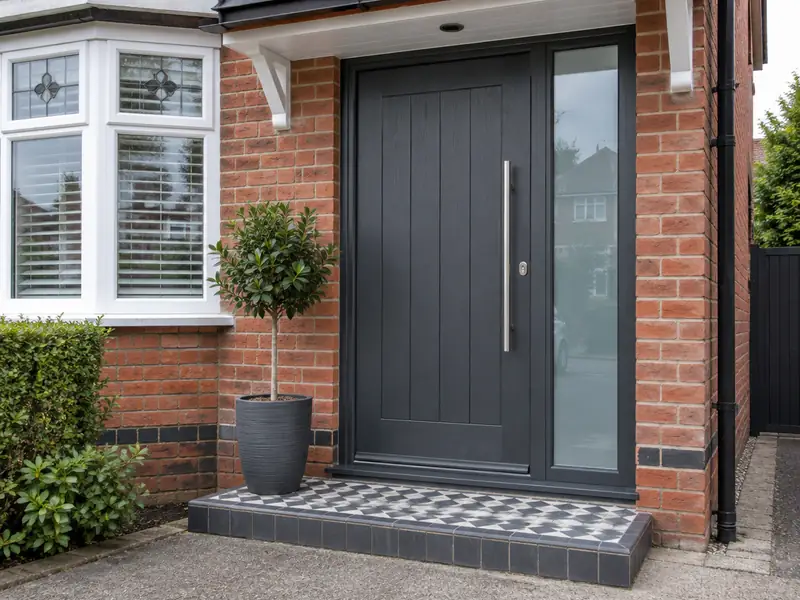
A replacement front or back door is a new door and frame, usually composite, uPVC or aluminium, made to fit your existing opening and fitted with multi-point locks and weather seals to improve security, warmth and kerb appeal.
Our guide for a new front or back door in the East Midlands comes to £950–£3,400 with VAT added, and that range applies across Derbyshire, including Derby, Chesterfield, Long Eaton and Ilkeston. Your own price depends on the size of the job, the specification and how easy it is to work on the site. We survey for free, check any consents needed under the rules in England, and then put the price in writing.
- Guide price
- £950–£3,400 inc VAT
- Time on site
- Usually half a day to one day per door
- Planning rules
- England
- Price level
- About 4% below the national guide
- Towns listed
- 12
- Survey
- Free, with a written quote
How much does a new front or back door cost in Derbyshire?
What will a new front or back door cost in Derbyshire? Our guide range is £950–£3,400 including VAT. That figure is adjusted for the East Midlands, about 4% below the national guide, and is intended for planning a budget. A firm written price for your chosen specification follows a free survey at your home.
| Type of job | What it usually involves | Guide in Derbyshire |
|---|---|---|
| uPVC back door | A standard uPVC back or side door with a half-glazed panel and multi-point lock. | £750–£1,450 |
| Composite front door | A made-to-measure composite door in your chosen colour, glass design and hardware. | £1,150–£2,400 |
| Aluminium or door with side panels | A premium aluminium door, or a composite door with one or two side panels. | £2,400–£4,800 |
Your price depends mostly on:
- Door material: uPVC, composite or aluminium
- Side panels, fanlights and the amount of glass
- Lock, cylinder and hardware specification
- Condition of the opening, threshold and surrounding brickwork
What’s included?
- Made-to-measure door and frame in your chosen colour and design
- Multi-point locking with anti-snap cylinders and matching handles
- Glazing panels, side panels or fanlights where specified
- Low threshold options for level or easier access
- Weather seals, sealant and internal trims finished neatly
- Building regulations paperwork where a glazed door needs it
Housing across Derbyshire
Derby has wide areas of Victorian red-brick terraces and interwar semis, while Peak District villages use gritstone and limestone under stone-slate or Welsh slate roofs. Former mining towns in the north-east of the county have brick terraces and post-war housing built for mining communities, and modern estates have grown around Derby, Chesterfield and the M1 corridor.
Brick terraces frequently suit loft conversions and rear extensions, and many need repointing. Stone properties in the Peak may call for lime work and planning-sensitive windows, while interwar and estate homes commonly take side extensions and garage conversions.
The High Peak gets heavy rain, snow and frequent frost, while the lower Trent valley is milder; old mine workings can also affect ground conditions in places.
Planning and building rules in Derbyshire
For anyone in Derbyshire, the relevant framework is England's. The summary below is general, so we always contact the council about your address before putting a price in writing.
Replacing windows and doors on a house is usually permitted development in England when the new ones look broadly similar to the old. Flats, listed buildings and homes covered by an Article 4 direction can need consent, and conservation areas may limit materials or styles.
Replacement windows and external doors must meet Building Regulations for energy efficiency, ventilation and, on upper floors, escape. The work is either self-certified by an installer registered with a competent person scheme or signed off by building control.
Rules change and every property is different, so we check the planning history and constraints for your address before we quote.
From survey to handover
We look at the job
It starts with a survey at the property, free of charge. We check condition, access and services, ask how you want the finished result to look, and answer any questions you have about a new front or back door.
Written quote
The quote arrives in writing, not over the phone. It covers the full scope, the finishes you've chosen, any exclusions and the payment schedule, with a fixed price tied to that specification.
Booking the work
With the quote agreed, we book the work in and handle preparation: permissions where needed, building control notifications, material orders and access arrangements for your Derbyshire property.
Finish and handover
Our trades complete a new front or back door while your point of contact keeps you updated. When everything is finished, we clear the site, take away waste and go through the result with you before handover.
How we work
Questions about a new front or back door in Derbyshire
How long will a new front or back door take?
On a typical home, allow Usually half a day to one day per door. Larger projects, older buildings and extra work found once things are opened up can extend that, while simpler jobs may be shorter. Your quote includes an estimate of time on site, and your point of contact keeps you updated on the programme as the work progresses.
Do I need permission to change my front door?
Planning permission is not usually needed to replace a front door, but it depends on the style and size of the change, your home's location, whether it is listed or in a conservation area, and which UK nation you are in. Listed homes generally need consent for any change, and some conservation areas control colours and styles. Flat entrance doors in shared buildings must also meet fire rules. We check before quoting.
How do I look after a composite or uPVC door?
Looking after a composite or uPVC door is mostly a matter of regular cleaning with warm soapy water and a soft cloth. Avoid solvents and abrasive pads, which can dull the finish. Once or twice a year, lightly oil the lock mechanism and the moving parts along the edge of the door, and check the seals. If the door starts to catch, the hinges can usually be adjusted easily.
Can I have a low threshold for wheelchair or pushchair access?
A low threshold is a flat or very shallow sill that makes a doorway easier to cross with a wheelchair, walking frame or pushchair. Most composite, uPVC and aluminium doors can be supplied with one. The outside ground level and drainage need checking, because a low threshold must still keep rainwater out. We look at this during the survey and suggest a channel drain or small ramp if needed.
Who do I deal with during the job?
One point of contact manages your project from survey to handover. They schedule the trades working under our contract, keep you updated on progress, and are the person to call with any question. You don't need to coordinate builders, electricians or decorators separately, because that is part of what we do.
Towns in Derbyshire
Choose your town from the list to see how we price and plan a new front or back door in your part of Derbyshire, including typical time on site.